

Online Medical & Clinical Score Calculators for Hospitals & Labs
Healthcare teams perform dozens of clinical and diagnostic calculations every single day. From ICU scoring to renal function assessments, these numbers directly influence treatment decisions. Managing them manually not only takes time but also increases the risk of avoidable errors.
MocDoc brings essential medical and clinical score calculators together in one practical workspace. Whether it’s a stroke scale, a renal function score, or an ICU severity assessment, these tools are built to support real hospital and laboratory workflows. By reducing repetitive calculations and standardizing scoring, clinicians can move faster, decide with confidence, and focus more on patient care.
#REF-99201-B
10
pointsECG Analysis
NIH Stroke Scale
GFR & CKD-EPI
Clinical Score Calculators for Emergency, ICU Inpatient Care
Free APGAR Score Calculator
Assess the physical condition of a newborn immediately after birth using the APGAR scoring system.
Use cases:
- Newborn health assessment at 1 and 5 minutes
- Identification of need for immediate medical intervention
- Neonatal monitoring in delivery rooms and NICUs
qSOFA Score Calculator
Quickly screen patients with suspected infection to identify risk of poor outcomes using qSOFA criteria.
Use cases:
- Early sepsis risk screening
- Emergency and ward-level patient assessment
- Rapid clinical decision support in suspected infections
Glasgow Coma Scale (GCS) Calculator
Evaluate a patient's level of consciousness based on eye, verbal, and motor responses.
Use cases:
- Neurological assessment in head injury
- ICU and emergency care monitoring
- Ongoing evaluation of critical or trauma patients
CHA₂DS₂-VASc Score Calculator
Estimate stroke risk in patients with non-valvular atrial fibrillation to support anticoagulation decisions.
Use cases:
- Stroke risk stratification in atrial fibrillation
- Anticoagulation therapy planning
- Standardized cardiology risk assessment
SOFA Score Calculator
Evaluate organ dysfunction and severity of illness in critically ill patients using the SOFA score to monitor progression and guide ICU care.
Use cases:
- Assessment of organ failure in ICU patients
- Monitoring disease progression in sepsis and critical illnes
- Supporting prognosis and treatment decisions
pGCS Score Calculator
Assess neurological status in infants and children using the Pediatric Glasgow Coma Scale to evaluate consciousness and guide pediatric care.
Use cases:
- Pediatric neurological assessment in emergency settings
- Monitoring consciousness levels in head injury or illnes
- Supporting clinical decisions in pediatric ICU and wards
Clinical Disclaimer: These calculators are intended to support clinical decision-making and should be used in conjunction with professional judgment and institutional protocols.
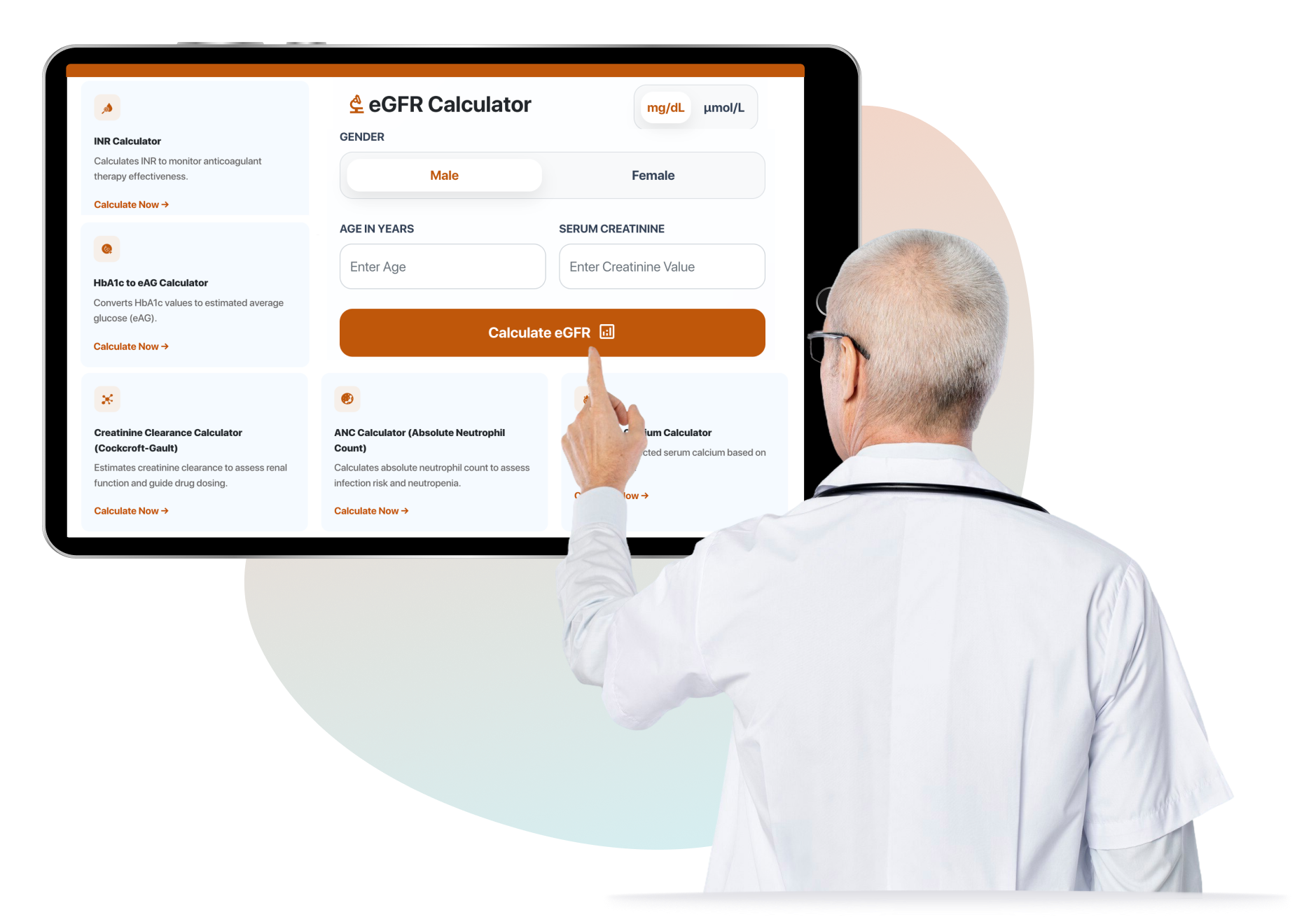
eGFR Calculator (CKD-EPI Kidney Function Calculator)
Estimate kidney function using the CKD-EPI equation for early detection and monitoring of chronic kidney disease.
Use cases:
- Chronic kidney disease (CKD) assessment
- Ongoing kidney function monitoring
- Renal dose adjustment for medications
Corrected Calcium Calculator
Assess true calcium levels by adjusting total serum calcium based on albumin values, helping detect hidden hypo- or hypercalcemia.
Use cases:
- Evaluation of calcium imbalance in hypoalbuminemia
- Accurate interpretation of serum calcium levels
- Clinical decision support in metabolic and critical care settings
Creatinine Clearance Calculator (Cockcroft-Gault)
Calculate creatinine clearance to support renal dosing and inpatient monitoring.
Use cases:
- Medication dose adjustment in renal impairment
- Kidney clearance evaluation
- ICU and inpatient renal monitoring
ANC Calculator (Absolute Neutrophil Count)
Quickly calculate ANC values to assess infection risk in immunocompromised patients.
Use cases:
- Infection risk assessment
- Oncology and chemotherapy monitoring
- Immunocompromised patient care
HbA1c to eAG Calculator
Convert HbA1c values into estimated average glucose (eAG) for clearer interpretation of glycemic control.
Use cases:
- Diabetes monitoring and follow-up
- Patient counseling and education
- Tracking treatment effectiveness
INR Calculator (PT to INR Conversion)
Convert Prothrombin Time into International Normalized Ratio for standardized anticoagulation monitoring.
Use cases:
- Anticoagulant therapy monitoring
- Bleeding and clotting disorder assessment
- Pre-surgical and perioperative evaluation
Clinical Disclaimer: These calculators support laboratory analysis and diagnostic interpretation. Results must be verified against validated reference ranges and institutional laboratory protocols before reporting.
Quickly Find The Right Medical Calculator
| Calculator Name | Purpose | Use Case | Free Online Tool | Integration (HMS/LIMS) |
|---|---|---|---|---|
| APGAR Score Calculator | Assess newborn health immediately after birth | Newborn evaluation at 1 and 5 minutes; NICU monitoring; identification of urgent interventions | Yes | MocDoc HMS – NICU Module |
| qSOFA Score Calculator | Screen patients for sepsis risk | Emergency & ward-level assessment; early detection of sepsis; rapid clinical decision support | Yes | MocDoc HMS – Emergency & Ward Module |
| Glasgow Coma Scale (GCS) | Evaluate patient consciousness | Head injury assessment; ICU & emergency monitoring; ongoing neurological evaluation | Yes | MocDoc HMS – ICU Module |
| CHA₂DS₂-VASc Calculator | Estimate stroke risk in atrial fibrillation | Anticoagulation planning; cardiology risk assessment | Yes | MocDoc HMS – Cardiology Module |
| eGFR Calculator (CKD-EPI) | Estimate kidney function | Chronic kidney disease assessment; renal dose adjustment; lab reporting | Yes | MocDoc LIMS – Clinical Result Processing |
| GFR Calculator (Glomerular Filtration Rate) | Assess overall kidney performance | CKD staging; renal function monitoring; long-term kidney health | Yes | MocDoc LIMS – Clinical Result Processing |
| Creatinine Clearance (Cockcroft-Gault) | Calculate kidney clearance for medication dosing | Renal dosing; ICU and inpatient monitoring | Yes | MocDoc LIMS – Clinical Result Processing |
| Absolute Neutrophil Count (ANC) | Assess immune health | Oncology/chemotherapy monitoring; immunocompromised patient care | Yes | MocDoc LIMS – Clinical Result Processing |
| HbA1c to eAG Calculator | Convert HbA1c to estimated average glucose | Diabetes management & patient counseling; glycemic control tracking | Yes | MocDoc LIMS – Clinical Result Processing |
| INR Calculator | Standardize anticoagulation monitoring | Anticoagulant therapy; bleeding/clotting assessment; pre-surgical evaluation | Yes | MocDoc LIMS – Clinical Result Processing |
All-in-One Medical Calculator Suite for Hospitals, Clinics & Labs
MocDoc offers a unified suite of medical calculators, laboratory calculations, and clinical score calculators that support diagnostic accuracy, clinical risk assessment, and day-to-day decision-making across healthcare settings.

Medical Practice
It used in routine clinical practice and specialty care.

Laboratory calculators
It assist with accurate result interpretation and reporting.

Clinical score calculators
SOFA and other standardized hospital scoring systems used in OPD, IPD, ICU, and emergency care.
By bringing these calculators together in one platform, healthcare teams can avoid switching between multiple tools or manual references. This helps maintain consistent calculation logic, improves workflow efficiency, and supports better coordination between clinical and diagnostic teams.
Who Can Use Medical Calculators & Diagnostic Health Tools?
MocDoc’s calculator tools are designed for a wide range of healthcare professionals, including:







Why Hospitals and Labs Need Integrated Medical Calculators
Modern healthcare depends on accurate interpretation of both laboratory results and clinical indicators. Medical and clinical score calculators help convert raw data into meaningful insights for diagnosis, risk assessment, and treatment decisions across hospitals and diagnostic centers. When used alongside a hospital management system (HMS) or laboratory information management system (LIMS), these calculators improve accuracy, ensure consistency in clinical evaluations, and reduce manual effort by eliminating reliance on external tools.

Reduced Operational Load

Standardized Risk Assessment
Integrated Medical Calculators for HMS, LIMS & CMS Workflows
While these calculators can be used individually, their real value is realized when they are part of everyday clinical and diagnostic workflows. Integrated calculators ensure results are consistently available within patient records, laboratory reports, and care pathways, reducing duplication and improving coordination across departments.
Use Calculators Within MocDoc Platforms
MocDoc HMS for Hospital
Clinical score calculators integrated into OPD, IPD, ICU, and emergency workflows to support real-time clinical assessment and decision-making.
Explore HMSMocDoc LIMS for Laboratories
Medical calculators embedded within laboratory workflows to support accurate result interpretation, reporting, and diagnostic consistency.
Explore LIMSReady to Strengthen Clinical Decisions Across Labs and Hospitals?
MocDoc’s medical and clinical score calculators are designed to work seamlessly within hospital management systems (HMS) and laboratory information management systems (LIMS), helping healthcare teams turn calculations into actionable insights across care settings.
Explore how MocDoc supports smarter workflows for hospitals, clinics, and diagnostic laboratories.
Frequently Asked Questions About eGFR Calculator
Medical calculators convert clinical and laboratory data into meaningful values that support diagnosis, treatment planning, and patient monitoring. They help healthcare professionals quickly calculate parameters such as kidney function, infection risk, glycemic control, and anticoagulation status, improving accuracy and reducing manual errors.
Medical calculators typically use laboratory values or clinical measurements such as eGFR, INR, or HbA1c to eAG. Clinical score calculators combine multiple parameters, including clinical signs, vital parameters, and sometimes laboratory values, to assess disease severity or risk using standardized scoring systems like SOFA, qSOFA, GCS, and APGAR.
Yes. Online medical calculators are accurate when they use validated formulas and are applied appropriately. Calculators within healthcare platforms like MocDoc align with widely accepted clinical standards, helping improve consistency and reliability in clinical and laboratory workflows. However, they should support, not replace, clinical judgment.
Hospitals commonly use clinical score calculators such as SOFA, qSOFA, GCS, APGAR, and CHA₂DS₂-VASc, along with medical calculators like creatinine clearance, INR, and eGFR. These tools support decision-making across OPD, IPD, ICU, and emergency care.
Diagnostic laboratories frequently use calculators such as eGFR, creatinine clearance, ANC, HbA1c to eAG, and INR. These calculators help interpret test results accurately and support consistent reporting for clinicians.
Yes. Medical and clinical score calculators can be integrated into hospital management systems and laboratory information management systems. When integrated, calculations can be performed directly within patient records and lab reports, reducing manual data entry and improving efficiency.
The CKD-EPI-based eGFR calculator is widely used for estimating kidney function and is considered more accurate than older formulas such as MDRD in many clinical settings. It is commonly used for assessing and monitoring chronic kidney disease.
Clinical score calculators help clinicians quickly assess patient severity and risk in time-critical environments. Scores such as SOFA, qSOFA, and GCS support early intervention, prioritization of care, and standardized communication among clinical teams.
Yes. MocDoc provides a unified set of medical and clinical score calculators designed for use across hospitals, clinics, ICUs, and diagnostic laboratories. These calculators support both standalone use and integration within HMS and LIMS workflows.
MocDoc brings essential medical and clinical calculators into a single platform, helping improve consistency, reduce manual effort, and provide seamless access within clinical and diagnostic workflows. This enables healthcare teams to make faster, more informed decisions.