

Choosing the Right Hospital Management Software: Simplicity vs Flexibility
Posted On
2026070413:22:12
By
Mohammed Siddiq
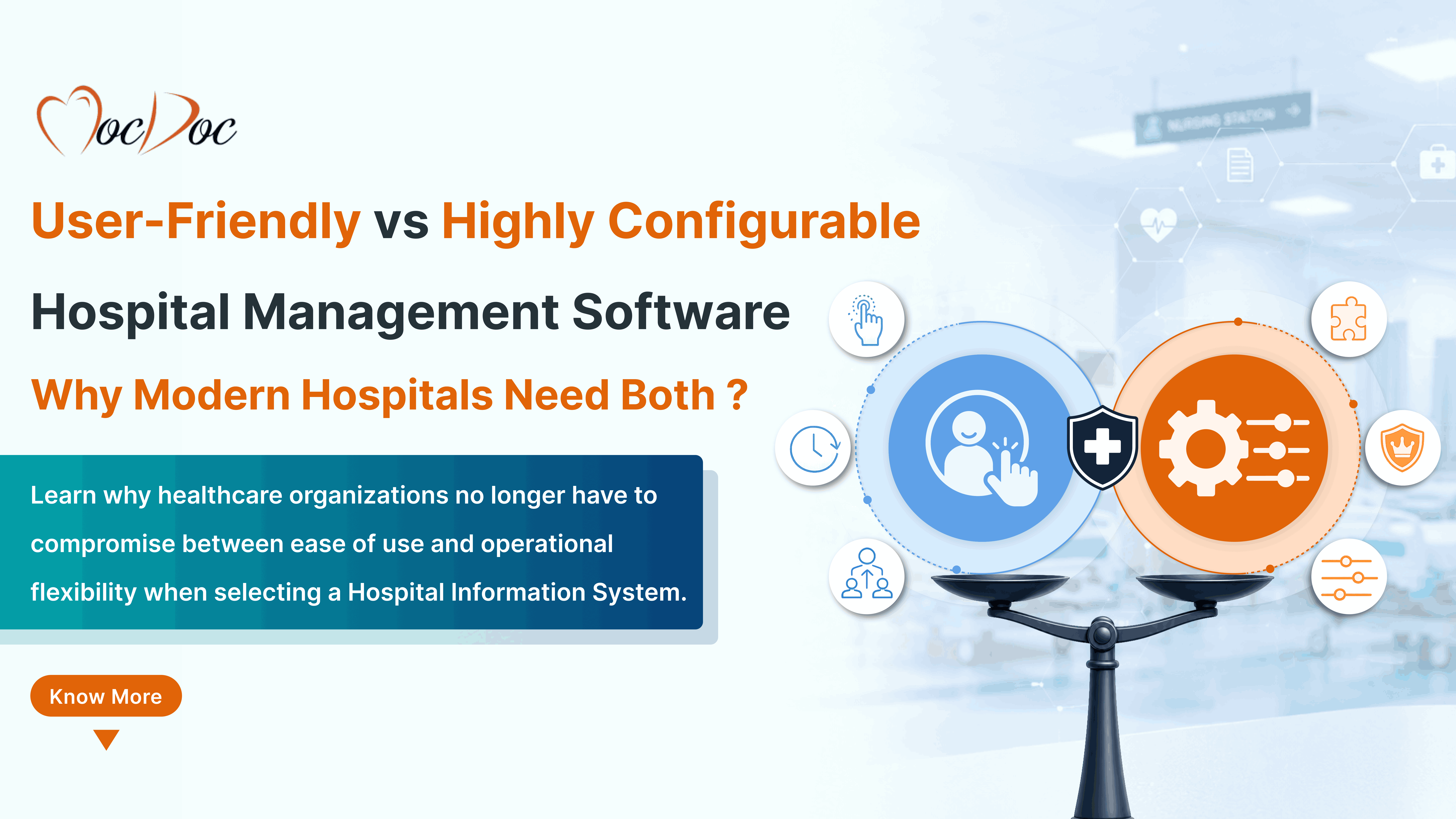
Selecting a Hospital Management Software (HMS) is no longer just about digitizing patient records or automating billing. Today's healthcare organizations need software that supports complex operational workflows while remaining simple enough for doctors, nurses, receptionists, laboratory technicians, pharmacists, and administrators to use every day.
Unfortunately, many hospitals find themselves forced to compromise.
Some Hospital Management Systems are incredibly easy to use but lack the flexibility required to support real-world hospital operations. Others offer extensive features and customization but become so complex that users struggle to navigate the software efficiently.
The ideal Hospital Information System should eliminate this trade-off.
When User-Friendly Software Isn't Enough
Many modern healthcare applications prioritize attractive interfaces and minimal learning curves.
While this makes onboarding easier, hospitals often discover limitations as they grow.
Common challenges include:
- Fixed workflows that cannot adapt to hospital-specific processes
- Limited approval mechanisms
- Inflexible billing workflows
- Minimal laboratory and pharmacy customization
- Difficulty handling specialty-specific requirements
- Lack of configurable authorization levels
Initially, the software feels simple.
Eventually, hospitals begin changing their processes to fit the software instead of the software adapting to the hospital.
When Powerful Software Becomes Difficult to Use
At the other end of the spectrum are enterprise-grade Hospital Information Systems packed with features.
While these solutions may support almost every business scenario, they often introduce another problem.
Complexity.
Users frequently experience:
- Multiple screens to complete a simple task
- Difficult navigation
- Steep learning curves
- Extensive staff training requirements
- Higher operational errors
- Reduced productivity
A powerful system loses its value if users hesitate to use it.
The Real Requirement: Simplicity Without Limitations
Healthcare professionals do not want software that is merely beautiful.
They want software that allows them to complete their work quickly and accurately.
Hospital administrators need configurable workflows.
Doctors need fewer clicks.
Receptionists need faster registration.
Laboratory technicians need streamlined processing.
Pharmacists need flexible billing and inventory management.
Finance teams need configurable approval and billing workflows.
Every department has different expectations, yet everyone expects the software to remain easy to use.
Why Modern Hospitals Need Configurable Workflows
Every hospital operates differently.
A multispecialty hospital, diagnostic laboratory, fertility center, dialysis center, oncology hospital, and day-care clinic rarely follow identical processes.
Examples include:
- Multi-level approval workflows
- Customized laboratory processing
- Department-specific billing rules
- Insurance-specific billing
- Credit organization workflows
- Referral management
- Pharmacy pricing rules
- Specialty-specific EMR templates
These cannot be addressed using a "one-size-fits-all" application.
The software should adapt to the hospital—not the other way around.
The Ideal Hospital Management Software Balances Both
The most successful Hospital Information Systems achieve two goals simultaneously.
1. A User-Friendly Experience
Everyday tasks should require minimal clicks and intuitive navigation.
This helps:
- Reduce staff training time
- Improve adoption
- Increase operational efficiency
- Minimize user errors
- Improve patient service
2. Configurable Business Workflows
Underneath the easy-to-use interface should lie an intelligent configuration engine that can handle different configurations of the hospital system without making the application complicated to use.
The hospital systems should be allowed to configure workflows according to their own needs but at the same time show options to the users.
How MocDoc Bridges the Gap
MocDoc has been designed around a simple philosophy:
Keep everyday operations simple while making complex workflows configurable.
Rather than inundate the user with unnecessary choices, MocDoc provides a clear interface for day-to-day tasks.
On the one hand, administrators can set up workflow procedures for billing, labs, pharmacies, approvals, specialties, insurances, diagnostics, referrals, inventory, and various other functions.
The two together mean that organizations are able to make life simpler for their users without reducing operational flexibility.
The Result
Hospitals using an intuitive yet configurable Hospital Management Software can expect:
- Faster staff onboarding
- Higher user adoption
- Reduced training efforts
- Improved operational efficiency
- Better compliance with hospital workflows
- Lower resistance to digital transformation
- Greater long-term scalability
Conclusion
Selection of Hospital Management Software shouldn’t come down to choosing one at the expense of another – simplicity or flexibility.
A good healthcare software provides its users with easy-to-use GUI while enabling hospitals to tailor their workflows according to their specific requirements.
That's the balance modern healthcare organizations should expect from their HMS.


