How AI Medical Scribes Structure Clinical History and Treatment Plans
Posted On
2026101313:22:12
By
Mohammed Siddiq
Introduction:
A great amount of doctors' workday is spent listening to their patients, diagnosing symptoms, making clinical decisions, and preparing medical records. At the same time, clinical documentation might require a significant amount of time and repetitive tasks that could be spent on patient care instead.
An AI-based hospital management system might be a great tool for solving these issues. Using AI in documentation makes it possible to introduce smart medical scribing to the existing routine and automate clinical record organization.
Solutions like MocDoc SenZ combine AI in hospital management to help doctors with clinical documentation and keep them in charge of clinical decisions.
How AI Scribes Integrate With HMS and Structure Clinical History
HMS covers all major processes within the hospital – patient registration, consultations, medical records preparation, prescribing drugs, lab services, and billing. The integration of an AI-based medical scribe system with HMS would help introduce clinical documentation as an integral part of the existing workflow.
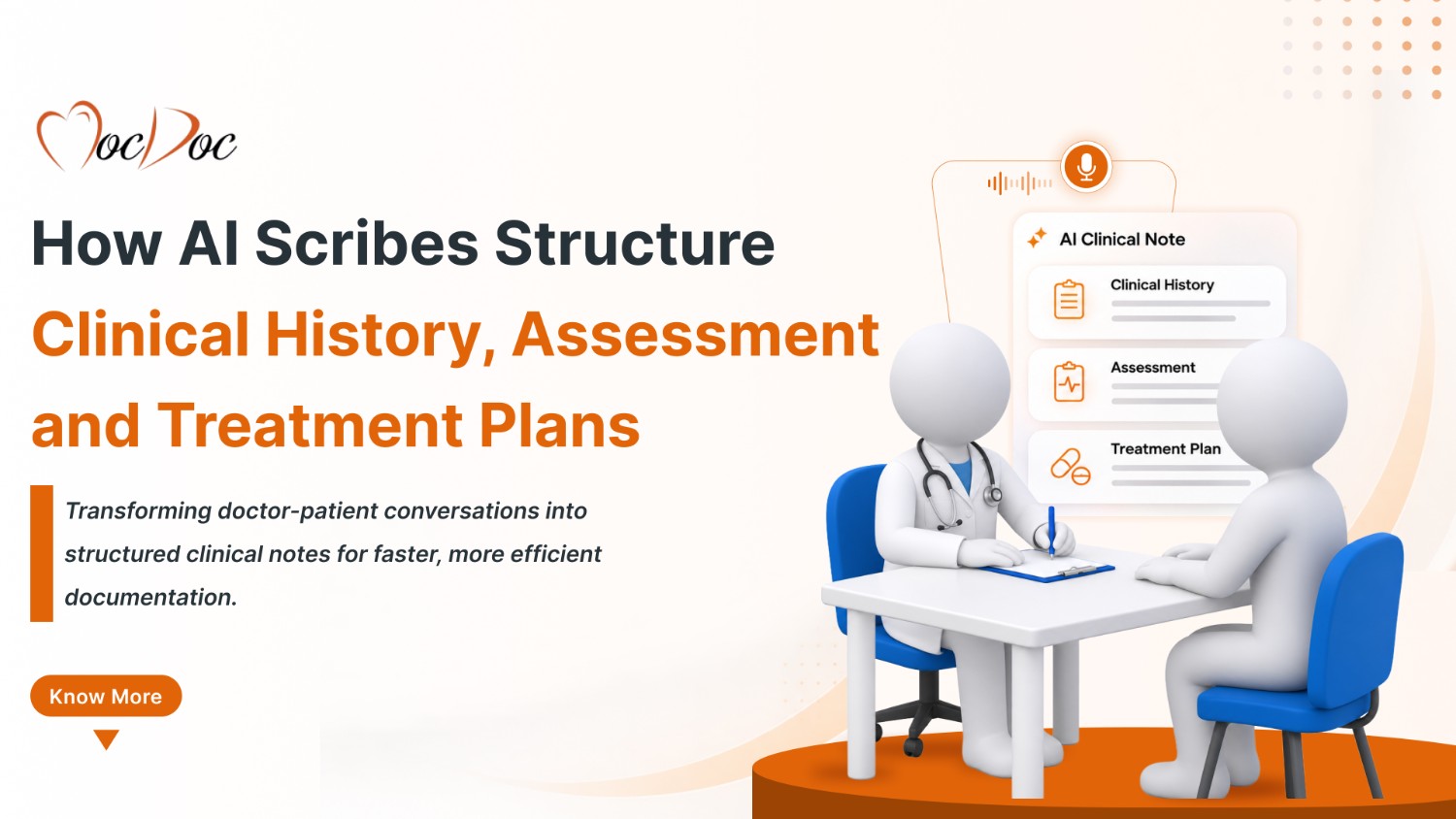
Here is how AI scribes may help structure clinical history documentation:
- Record the discussion between a doctor and a patient: AI records the discussion, extracts clinically meaningful data from it, and records it automatically.
- Structure the patient's history: This way, the system can organize the information in a form of chief complaint, duration of symptoms, additional symptoms, medical history, etc.
- Eliminate redundant work: Rather than writing everything down by themselves, doctors can simply edit the generated data.
- Connect the notes to EMR: In case when the system is connected to the AI-driven EMR system, the notes can be stored in the proper EMR document.
In this way, the system helps to structure the medical documentation better and allows doctors to spend less time on the documentation process itself and more time talking with their patients.
How AI Scribes Can Assist with Clinical Assessment and Treatment Plans
Clinical assessment implies careful evaluation of the symptoms, patient's history, examination results, and other information. AI-assisted scribes could help structure the necessary information to review it easily.
- Structural clinical assessment: AI structures symptoms, relevant medical history, examination results, and other information into corresponding sections for easy review.
- Documenting the diagnosis: Based on the consultation, AI can assist in documenting the diagnosed condition. Sometimes, ICD-10 coding can be added as well (with healthcare professionals' approval).
- Documentation of the treatment plan: The treatment plan discussed by the doctor is structured in order to document medicines to be prescribed, their dosages, investigations, etc.
- Clinical decision support: When an HMS is combined with Clinical Decision Support System (CDSS), it can allow doctors to review the alerts, clinical guidelines, and other related information. This depends on the current configuration and clinical data.
- Continuity of care: Structured notes will help the healthcare professionals review previous consultations, understand the treatment decisions, and plan follow-ups.
AI assists in documentation but cannot make any clinical decisions. Doctors still have to verify diagnoses, prescriptions, dosages, and treatment plans.
MocDoc SenZ: AI Medical Scribe for Indian Hospitals
MocDoc SenZ is an AI-based clinical documentation solution designed for hospitals, multispecialty clinics, and dental practices of India. It automatically transforms clinically relevant information from natural conversations or dictation into documentation that can be reviewed and approved by doctors.
MocDoc SenZ provides two options for documentation:
- Transcribe: It captures clinically relevant details from consultations and structures them into structured clinical notes. SenZ can support OP and IP consultations workflow.
- Transcript: SenZ converts doctors' speech into clinically relevant English text in selected fields. It can be useful to prepare physician notes, inpatient documentation, and discharge summaries.
MocDoc SenZ can support clinically relevant natural conversations and field-level dictations in seven Indian languages – English, Hindi, Tamil, Telugu, Kannada, Malayalam, and Marathi. This feature is particularly useful in Indian healthcare facilities since doctors and patients can change their language during a consultation.
By supporting natural conversations and field-level dictations, SenZ allows reducing repetitive typing without changing the documentation process.
MocDoc: AI-Based Hospital Management Software
All the benefits of AI are becoming really tangible when documentation becomes integrated with the existing workflow of the facility. SenZ comes as a module in the Hospital and Clinic Management and EMR platform developed by MocDoc.
Benefits of MocDoc software include:
- Connected patient records: Approved clinical documentation can be automatically connected with the appropriate EMR records, allowing structured access to patient data.
- Support of all clinical workflows: AI-based documentation can be used in OP consultations, IP documentation, discharge summaries, clinical notes, and dental consultations.
- No need in constant context switching: Doctors can use the existing MocDoc environment without switching between separate documentation tools.
- More efficient daily work: Integrated OPD, IPD, laboratory, pharmacy, appointments, and billing workflows allow managing various operational processes through one platform.
- Human approval: Doctors are responsible for reviewing generated notes and approving the final clinical record.
AI can be used for various purposes in addition to documentation. MocDoc's AI-based capabilities also include supplier invoice processing to prepare GRN, inventory purchase planning based on inventory consumption, and AI-based analysis of MIS reports.
These features address different challenges within hospital administration, pharmacy operations, and management.
All in all, this is a demonstration of how AI in hospital management can be applied to both documentation and operational activities.
Conclusion: Give Doctors More Time for Patient Care
Clinical documentation is crucial to the safety and organization of healthcare but shouldn't become a barrier between doctors and their patients. AI medical scribing allows organizing clinical history, documentation of assessments, and treatment plans while reducing repetitive manual work.
Thanks to multilingual support, structured notes generation, field-level dictation, and EMR integration, MocDoc SenZ becomes close to clinical reality. With other capabilities of MocDoc Hospital Management Software, it allows for a more connected approach to clinical and administrative workflows.
The key idea is simple: fewer hours spent on typing, more organized documentation, and more time for communication with patients.
Are you ready to make clinical documentation simpler at your hospital or clinic?
Book a demo of MocDoc SenZ to see how AI medical scribing can be introduced into your clinical routine.