How AI-Powered EMR Is Transforming Digital Healthcare
Posted On
2026092913:22:12
By
Mohammed Siddiq
Electronic Medical Record (EMR) is already in use for managing patient records and information at hospitals and clinics. Information such as medical history, clinical notes, medications, diagnosis, and other details are easily accessible by physicians, without relying on the physical paper-based documents.
But now, there is a new challenge faced by healthcare providers: What if we could make the use of EMRs more useful?
That's when the idea of an AI powered EMR comes in.
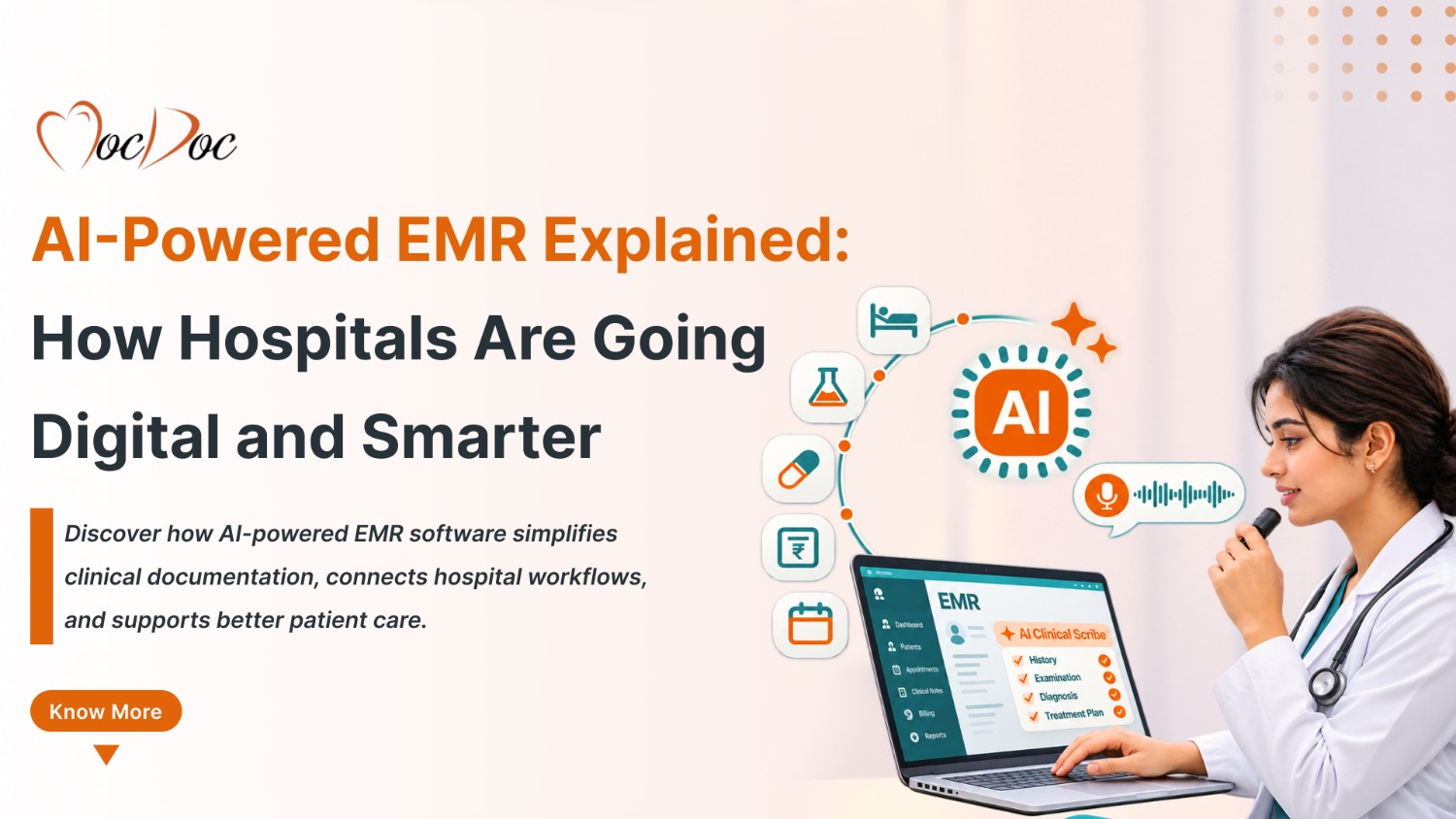
In its conventional sense, an EMR helps healthcare professionals manage the information. An AI powered EMR assists in certain workflow tasks like clinical documentation, transcription, information management and clinical decision-making.
The goal is not to replace doctors, but to cut down the repetitive work.
Generic EMR vs AI-Powered EMR
The main difference is how the system works with clinical information.
| Feature | Generic EMR | AI-Powered EMR |
| Patient Records | Stores electronic patient records | Stores and can assist with processing clinical information |
| Clinical Documentation | Mostly manual entry | AI-assisted documentation |
| Consultation Notes | Doctor types notes | AI can help create structured notes from conversations |
| Speech-to-Text | May require separate tools | Can be integrated into the clinical workflow |
| Clinical Workflow | Mainly rule-based | Can include AI-assisted workflows |
| Decision Support | May use predefined rules | Can include AI-assisted CDSS capabilities |
| Doctor's Role | Creates and reviews documentation | Reviews, edits, and approves AI-assisted documentation |
| Patient Record | Digital storage | Digital record with intelligent assistance |
A generic EMR is still valuable because it creates a digital record of the patient. An AI-powered EMR adds another layer by helping healthcare professionals work with that information.
How Is AI-Powered EMR Transforming Hospitals into Modern Hospitals?
A modern hospital is not simply a hospital that has replaced paper with computers. It is a hospital where technology connects different parts of patient care.
An AI Powered Hospital Management System can bring together hospital operations, EMR, clinical documentation, pharmacy, laboratory, billing, appointments, and other workflows.
AI can make selected parts of these workflows easier.
Less Manual Documentation
Doctors often need to document the same types of information for every consultation. Typing each note manually can become repetitive, especially in busy OPDs.
MocDoc SenZ, the AI Clinical Scribe within the MocDoc platform, helps address this problem.
During a consultation, the doctor can speak naturally. SenZ processes the relevant information and prepares structured clinical documentation for the doctor to review, edit, and approve.
This can reduce repetitive typing without removing the doctor's control over the final record.
From Conversation to Structured Information
Consider a doctor discussing a patient's symptoms, history, vitals, diagnosis, and treatment plan.
Instead of manually entering every detail into separate sections, SenZ can assist in organising relevant information into structured clinical documentation.
The workflow is simple:
Consult → AI Generates → Doctor Reviews → Approve & Save
The final record is only saved after the doctor reviews and approves it.
Two Ways to Document
MocDoc SenZ provides two documentation methods.
Transcribe helps turn a consultation into structured clinical documentation. It is useful when the doctor wants to capture the overall consultation.
Transcript is designed for field-level dictation. A doctor can speak directly into a supported field, such as a physician note or discharge documentation field, and the speech is converted into clean English text.
This gives doctors flexibility instead of forcing every documentation task into the same workflow.
AI in Hospital Management: Beyond Documentation
AI in Hospital Management is not limited to medical scribing.
A broader AI Powered HMS Software can combine AI-assisted features with existing hospital workflows. Depending on the system, this can include clinical documentation, analytics, alerts, workflow automation, and clinical decision support.
For example, MocDoc also provides Clinical Decision Support System capabilities integrated with the EMR. Its CDSS offering is designed to provide clinical guidance using configured clinical logic and guideline-based support.
The important point is that AI should support the healthcare professional. Clinical judgement and responsibility remain with the doctor.
How Can Doctors Benefit from an AI-Powered EMR?
Spend Less Time Typing
Doctors can use natural speech for supported documentation workflows instead of manually typing every detail.
Stay Focused on the Patient
Reducing documentation effort can help doctors give more attention to listening, examining, and communicating with patients.
Complete Documentation More Easily
AI-assisted note creation can help reduce repetitive work during and after consultations.
Work Within the Existing EMR
MocDoc SenZ is built into the MocDoc Hospital & Clinic Management + EMR platform. This allows the AI documentation workflow to remain connected with the patient's existing record rather than functioning as a completely separate system.
MocDoc's EMR also supports specialised case sheets and automated prompts for clinical fields, helping structure documentation across different specialties.
MocDoc: NABH-Accredited AI-Powered EMR Software
For hospitals, choosing healthcare software is not only about adding new technology. Documentation, traceability, standardisation, patient safety, and compliance also matter.
MocDoc states that its Hospital Information System and EMR have achieved NABH accreditation, with its 2025 update describing accreditation for HIS and EMR.
MocDoc's current website also identifies its EMR and HMS as NABH Advanced Certified.
This gives healthcare organisations an EMR platform that combines structured digital records with AI-assisted capabilities such as MocDoc SenZ.
The broader MocDoc ecosystem covers areas including OPD, IPD, EMR, laboratory, pharmacy, billing, appointments, and hospital operations. This connected approach can help hospitals move towards more organised digital workflows.
Conclusion
An EMR has already made patient records more accessible and organised. An AI Powered EMR takes the next step by helping healthcare professionals work with clinical information more efficiently.
AI Clinical Scribe technology is one practical example. Instead of making doctors spend more time entering information, it can help turn natural clinical conversations into structured documentation that doctors can review and approve.
MocDoc SenZ brings this AI-assisted approach directly into the MocDoc EMR and Hospital Management System.
For hospitals looking to move towards AI Driven Hospital Management, the future is not simply about adding more technology. It is about making technology useful at the point where doctors and patients interact.
Less paperwork. Smarter documentation. More time for patient care.
Book a Demo
Want to see how an AI-powered EMR and AI Clinical Scribe can fit into your hospital workflow?
Book a Demo with MocDoc and explore MocDoc SenZ.
MocDoc SenZ — AI Clinical Scribe for Hospitals and Clinics.