

How Hospitals Can Prepare for AI Adoption
Posted On
2026101113:22:12
By
Mohammed Siddiq
Introduction:
There is a rapid development of the healthcare sector, which means that hospitals have a desire to enhance the way they deal with management, clinical processes, and staff. Artificial Intelligence (AI) is one of the most effective solutions in terms of the mentioned aspects. From clinical documentation to inventory management, AI may become really useful for dealing with repetitive processes and managing the routine in an efficient way.
Thus, the adoption of this technology requires more than just implementing the mentioned innovation. Preparation is crucial for maximizing the value of the AI adoption and keeping healthcare professionals in charge of making critical decisions. An AI-powered Hospital Management System (HMS) may contribute to this process significantly.
Advantages of Adopting AI in the Healthcare Sector
AI adoption can be beneficial for improving hospital's productivity, managing information, and using available resources effectively. There are some of the major advantages of AI adoption.
- Decreased manual labor: AI may automate administrative processes like processing supplier invoices, preparing inventory records, and clinical documentation;
- Improvement of the quality of clinical documentation: An AI-powered EMR may help doctors to convert patient consultations into clinical notes in a structure format, saving a lot of time for taking notes manually;
- Improved pharmacy inventory management: AI analysis may help in understanding the pattern of consumption and available stock. It will assist in making the right purchasing decisions, avoiding buying too many medicines and the lack of them in case of necessity;
- Easier access to the information: AI-based analytical tools can provide management reports with a summary of information and important trends. Hospital administrators can receive valuable insights;
- Assistance with making clinical decisions: A Clinical Decision Support System (CDSS) may help healthcare professionals to view relevant clinical information, alerts, and recommendations. Even though AI may be used in this field, all clinical decisions should be made by qualified professionals.
How Powerful Is an HMS Integrated with AI Facilities?
Traditional Hospital Management System deals with management of appointments, billing, pharmacy, laboratory operations, and patient records. When the features of AI become integrated into the system, hospitals may benefit from the improvement of mentioned functions.
Here are some of the advantages of an AI-driven Hospital Management System.
- Connection of Hospital Operations: The integration of AI capabilities and hospital management software makes it possible for the hospital to manage operations in a connected workflow without using multiple applications;
- Automation of Pharmacy Operations: The feature of AI-powered Goods Received Note (GRN) creation allows extracting the information from the supplier invoices and preparing structured GRN drafts. Then, staff reviews and approves the drafts and updates the inventory;
- Purchase Planning Improvement: AI-assisted generation of purchase orders provides the hospital with the use of the information related to historical consumption and stock. It is possible to find the right balance between the availability of products and inventory costs;
- Simplified Management Reporting: There is an opportunity to use the AI-powered MIS analytical tool for summarizing of available reports and highlighting of trends. Managers will be able to receive valuable insights and see what requires additional attention;
- Improved Clinical Workflow: The AI medical scribe technology will help to prepare the clinical notes faster without losing the connection to the patient's electronic medical record.
The true value appears when these capabilities are provided by the same system.
MocDoc SenZ:
One of the ways to prepare hospitals for AI adoption is to reduce the burden of the documentation from doctors. MocDoc SenZ is an AI medical scribe which is intended for the use of hospitals, multispecialty clinics, and dental practices in India.
It transforms doctor-patient consultations into the structured clinical documentation and allows doctors to review and approve the generated content for further use as a part of the patient's medical record.
There are two ways of using MocDoc SenZ:
- Transcribe: Captures the information from the conversation and puts it in the clinical notes in a structured format. This method can be used during outpatient (OP) and inpatient (IP) consultation workflow;
- Transcript: Translates spoken dictation to the text format within the fields of supported clinical notes. It will help in writing the discharge summary, inpatient note, physician note, and other documentation.
Key Features of MocDoc SenZ
- Languages Support: Supports the clinical conversation in English, Hindi, Tamil, Telugu, Kannada, Malayalam, and Marathi languages in order to accommodate the most common language requirements in the healthcare industry of India;
- Integration with EMR: Can work inside the MocDoc Hospital and Clinic Management platform to maintain the connection of clinical documentation with patient records;
- Reduction of the Documentation Effort: Provides the reduction of the repetitive typing and manual notes-taking, leaving doctors with extra time for communication with the patient;
- Doctors' Approval: Doctors remain in control of the checking and approving the generated documentation.
Thus, this solution is convenient due to the fact that it fits perfectly into the existing clinical workflow.
MocDoc: AI-Integrated Hospital Management Software
AI adoption becomes more realistic when there is the possibility to solve administrative, inventory, analytical, and clinical needs in a connected way. MocDoc brings AI assistance into the existing hospital management ecosystem.
Apart from the MocDoc SenZ, hospitals can consider the following AI-assisted features.
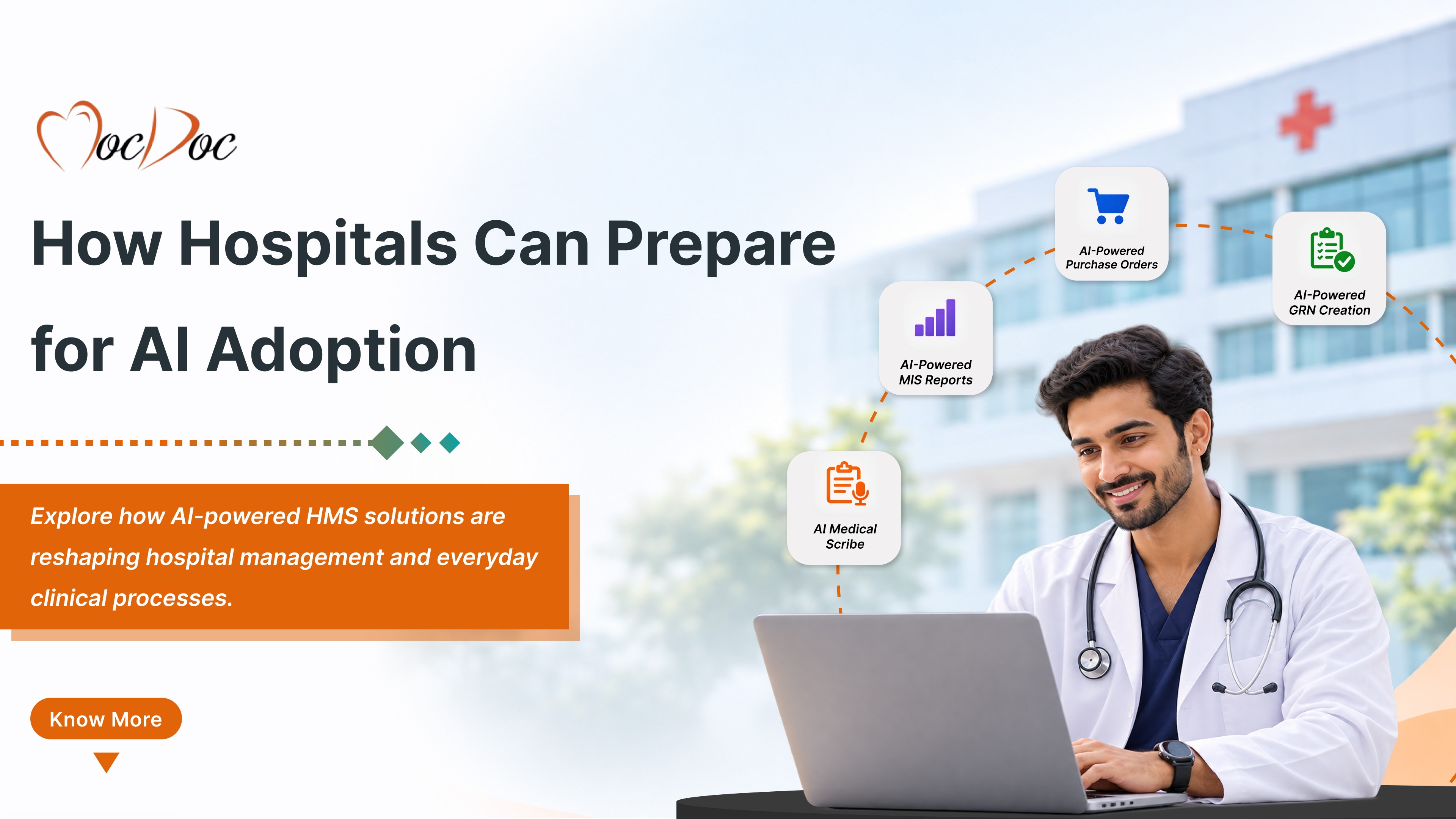
- AI-Powered GRN Creation: Extracts the information regarding purchases from supplier invoices and prepares the GRN drafts, which can be then reviewed and approved by staff;
- AI-Powered Purchase Order Generation: Uses the information related to historical consumption and the stock to assist with making replenishment decisions;
- AI-Powered MIS Analytical Tool: Interprets the information provided by available business reports and summarizes important trends to support more effective decision-making;
- AI Medical Scribe: Assists in creation of the clinical notes and documentation based on the voice.
All mentioned features solve different operational issues and can be useful for the organization of the workflow and effective use of staff.
Conclusion:
The adoption of AI is not about replacement of healthcare professionals. It is about providing them with the tool to work more efficiently, access information easier, and perform less repetitive tasks.
Hospitals should be prepared for this process by identifying operational issues, involving the staff in the adoption process, reviewing data quality, and choosing AI-powered HMS software, which integrates into the existing workflow. Also, hospitals should establish the process of review, protect patient information, and keep clinical decisions in the hands of professionals.
With the use of AI-powered hospital management software, intelligent inventory solutions, AI-assisted reporting, and MocDoc SenZ, hospitals can implement AI successfully into their processes.
Ready to explore AI for your hospital?
Discover how MocDoc's AI-integrated Hospital Management System and AI medical scribe can support your team's daily workflows.
Book a Demo with MocDoc today and take the next step towards smarter hospital management


