What Is an AI Medical Scribe? A Guide for Healthcare Providers
Posted On
2026091113:22:12
By
Mohammed Siddiq
Introduction
A doctor spends most of the day attending to patients, but a portion of the day is also taken up by clinical documentation. Writing consultation notes, maintaining patient files, making discharge summaries, and documenting clinical data may be very tedious and demanding.
Here is where an AI Clinical Scribe comes in handy.
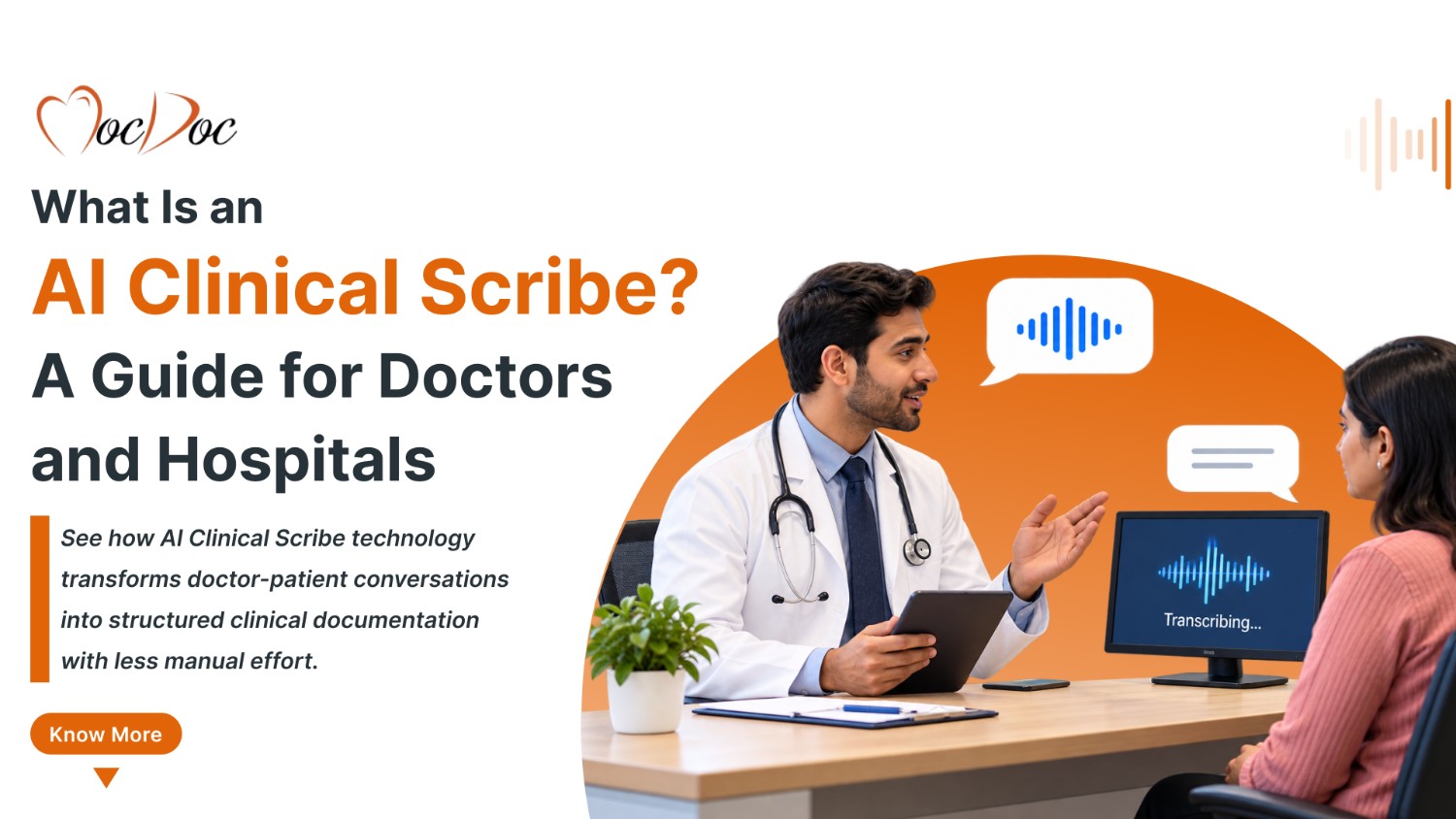
An AI Clinical Scribe assists in translating oral consultations or oral clinical notes between a doctor and a patient into medical documentation. Instead of inputting all data manually, the doctor will have to talk naturally while the document gets generated, corrected, and finally approved.
In the era of intelligent digital health care expected to start from 2026 onwards, AI medical scribe technology will go a long way in reducing the documentation burden for doctors while still maintaining control over the medical record of the patient.
Why Is AI Clinical Scribe Important for Healthcare in 2026–2027?
Digitalization is increasingly prevalent in healthcare. The increasing amount of information about patients in hospitals and the need for doctors to document the consultation precisely and effectively.
Documentation involves typing during the consultation, writing notes after the consultation, and extra work outside the working hours of the doctor. These may result in a diversion of attention from the patient.
The AI Medical Scribe allows doctors to record clinical information by conversing with the patient and using their voice as an input source. It allows the doctor to reduce typing efforts in documentation.
For hospitals, this benefit extends further than time-saving. It includes benefits such as the continuity of care, easy access to patient information, and better-connected clinical workflow.
How Should Doctors and Hospitals Adopt AI Clinical Scribe Before 2027?
Adopting an AI Clinical Scribe does not have to mean changing the entire way a hospital works.
The better approach is to introduce AI into the existing clinical workflow. Doctors should be able to consult, document, review, and save information without moving between multiple systems.
Hospitals should also consider how the AI scribe connects with their EMR and Hospital Management Software. The technology should support doctor review and approval rather than automatically becoming the final medical record.
A practical AI adoption approach includes:
- Start with OP consultations and routine documentation.
- Allow doctors to review and edit AI-generated notes.
- Integrate documentation with the existing EMR.
- Support the languages commonly used by doctors and patients.
- Extend the workflow to IP notes and discharge documentation.
- Maintain appropriate documentation, privacy, and approval processes.
The goal is simple: use AI to reduce administrative work without taking clinical responsibility away from doctors.
Hospital Management Software and AI Clinical Scribe with NABH-Aligned Workflows
The utility of AI Clinical Scribe increases further when it is used in the context of a Hospital Management Software which is integrated as a whole.
With the process of documentation and structuring of quality and documentation processes such as NABH compliant ones in mind for hospitals that are moving towards that direction, while AI can help out in documentation, hospitals need proper review, approval and access processes internally for compliance to regulations.
While MocDoc provides all hospital management processes, Hospital & Clinic Management, EMR, OPD, IPD, Lab, Pharmacy, Billing, Appointment and Clinical workflows together in an integrated system, MocDoc SenZ provides AI Clinical Documentation along with this suite.
This allows doctors to proceed from consultation to documentation and EMR approval in the same workflow.
What Is MocDoc SenZ?
MocDoc SenZ is an AI Medical Scribe and clinical documentation solution designed for hospitals, multi-specialty clinics, and dental clinics across India.
It listens to doctor-patient conversations, understands relevant clinical context, and converts the captured information into structured clinical documentation for the doctor to review, edit, and approve.
One AI. Two Ways to Document.
Transcribe: During an OP or IP consultation, doctors can speak naturally while SenZ captures relevant information and organizes it into structured clinical documentation.
Transcript: Doctors can dictate directly into supported clinical fields. Their speech is converted into clean English text without restructuring the content.
This makes SenZ flexible for consultations, IP notes, clinical notes, discharge summaries, and other documentation workflows.
From Conversation to Structured Clinical Documentation
The MocDoc SenZ workflow is designed to be simple:
Natural Conversation → AI Processing → Structured Clinical Documentation → Doctor Review → Approve & Save → EMR
4-Step AI Medical Scribe Workflow
01. Consult
The doctor speaks naturally with the patient in the language used during the consultation.
02. AI Generates
MocDoc SenZ processes the conversation and creates structured clinical documentation from the relevant information.
03. Doctor Reviews
The doctor reviews the generated content and makes any required corrections or clarifications.
04. Approve & Save
After approval, the documentation is saved into the appropriate EMR record within MocDoc.
The result is a simpler documentation process with less manual typing and less after-hours charting.
AI Medical Scribe for Smarter Clinical Documentation
Clinical documentation is different across departments and specialties. MocDoc SenZ is designed to support AI-assisted documentation within the clinical workflows available in MocDoc.
It can support:
- OP consultations
- IP documentation
- Discharge summaries
- Clinical notes
- Doctor and physician notes
- Nursing documentation
- Dental consultations
SenZ also supports multilingual clinical conversations in English, Hindi, Tamil, Telugu, Kannada, Malayalam, and Marathi, helping it fit more naturally into real-world Indian healthcare settings.
Integrated with MocDoc EMR
One AI Scribe. One Workflow. One Patient Record.
MocDoc SenZ is built into the MocDoc Hospital & Clinic Management + EMR platform. Doctors do not need to move between a separate scribe application and the patient record.
The connected workflow brings together OPD, IPD, EMR, Clinical Case Sheets, Laboratory, Pharmacy, Billing, Appointments, and hospital operations.
This can reduce unnecessary context switching and make clinical documentation part of the existing hospital workflow.
Why MocDoc SenZ?
MocDoc SenZ brings together AI clinical scribing, clinical documentation, multilingual support, field-level transcription, and EMR integration in one connected platform.
Compared with manual documentation or a standalone AI scribe, the key difference is the connected workflow. Doctors can speak, review, edit, approve, and save clinical information within the MocDoc environment.
The focus is not simply on converting speech into text. It is on helping doctors create useful, structured clinical documentation while keeping the doctor responsible for the final record.
Conclusion
Clinical documentation will remain an important part of healthcare, but it does not have to become a burden on doctors.
As hospitals move toward more connected healthcare technology in 2026–2027, AI Clinical Scribe software can help reduce repetitive documentation and give doctors more time to focus on what matters most: their patients.
MocDoc SenZ – AI Clinical Scribe by MocDoc brings AI-assisted documentation directly into the hospital and clinic workflow.
Less typing. Less repetitive work. More time for patient care.
Give Doctors Their Attention Back
Book a Demo of MocDoc SenZ today and discover how AI-powered clinical documentation can fit into your hospital or clinic workflow