Best Ophthalmology Practice Management Software 2026 | MocDoc
Posted On
2026081613:22:12
By
Mohammed Siddiq
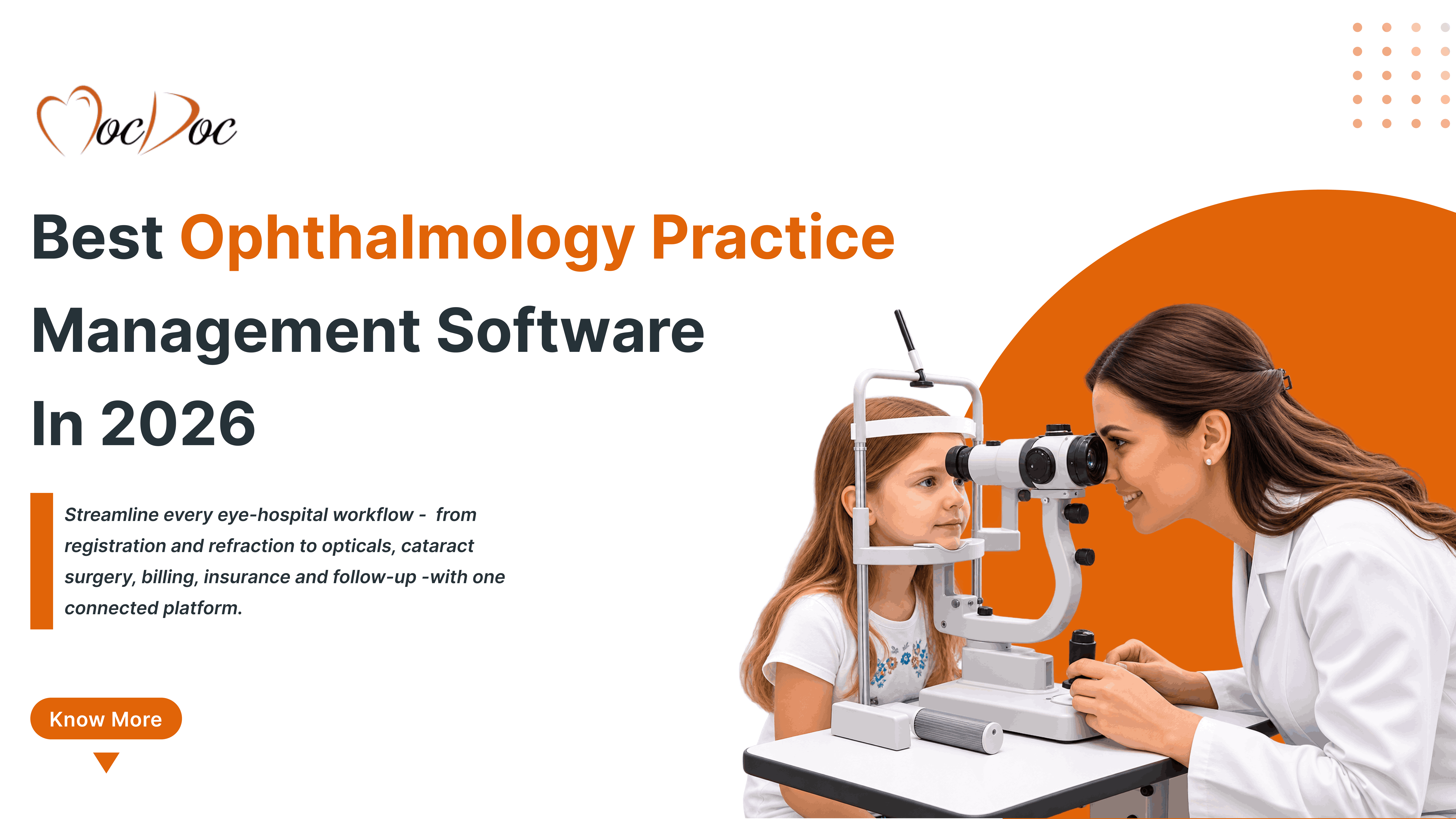
Operating an eye hospital of a larger size is quite different from operating a smaller one. Hundreds of patients go through registration, refraction, consultations, optical sales, counseling, surgeries, and post-operation processes each day. The slightest delay in such processes when done individually will have an impact on patient experience.
It is at this point that Ophthalmology Practice Management Software becomes really useful. It makes it easier for the eye hospital to manage its clinical operations, optical sales, surgeries, billing, and reporting from one single platform.
How Does a Large Eye Hospital Work?
A large eye hospital usually handles two major patient journeys: general eye care and refraction, and cataract evaluation and surgery.
The journey starts with patient registration. The hospital creates a patient profile, records previous visits and assigns the patient to the right department or doctor.
For general eye care, the patient normally starts with an optometrist. Vision testing, automated refraction (AR), eye pressure measurement and other preliminary assessments are completed before the patient meets the ophthalmologist.
The ophthalmologist reviews these findings, performs the clinical examination and decides the next step. The patient may receive a prescription, move to optical sales, undergo further investigations or be referred for surgery.
Cataract patients follow a more detailed journey because several teams need to work together before and after surgery.
Workflow of an Eye Hospital
The eye hospital workflow can be understood as a continuous patient journey:
Registration → Initial Assessment → Optometrist → Ophthalmologist → Diagnosis → Treatment / Optical / Surgery → Billing → Follow-up
For a patient requiring spectacles, the prescription can move directly into the optical workflow. The patient selects a frame, which can be identified through a barcode, while the lens can be managed as a service based on the prescription and required specifications.
The optical order can then move through billing, processing and delivery.
For a cataract patient, the journey becomes more structured:
Cataract Diagnosis → Counselling → Surgery Confirmation → Pre-Operative Investigation → Insurance → OT Booking → Surgery → Discharge → Follow-up
Here the role of the counsellor becomes crucial in terms of providing information regarding the procedure, package, price, insurance options, and future follow-ups. Once the consent from the patient is obtained, further investigation, clearance, and OT can be planned by the hospital.
In the case of multiple eye hospitals, there is an opportunity to increase the efficiency of the process through the implementation of the hub & spoke model. The branches can perform registration, refraction, consultation, opticals sale and cataract detection.
Where Does Ophthalmology Practice Management Software Come In?
The biggest advantage of practice management software is that it connects these individual activities.
Instead of maintaining separate records for registration, optometry, consultation, optical sales and surgery, the patient's information can follow them throughout the hospital.
For example, once an optometrist records AR and eye pressure results, the ophthalmologist can review them during consultation. If the patient receives a spectacle prescription, the optical team can access the required information without repeatedly asking the patient.
Similarly, when cataract surgery is recommended, the same patient record can move into counselling, surgery scheduling, OT booking, insurance and follow-up.
This creates a smoother workflow for both staff and patients.
What Are the Common Challenges?
Large eye hospitals often face challenges that are not related to medical expertise but to coordination.
Patient information may be spread across departments. Staff may need to make repeated calls to check whether a patient is ready for consultation or surgery. Optical inventory can become difficult to track across locations. Surgery schedules may change, and insurance claims can remain pending.
Multi-location hospitals also need clear visibility into branch performance. Management may want to know which branch is generating more patients, which doctors are handling more consultations, how many cataract patients are being converted into surgeries and how optical sales are performing.
Without centralized reporting, getting these answers can take time.
MocDoc – Best Ophthalmology Practice Management Software 2026
MocDoc brings the major workflows of an eye hospital together in a single healthcare management platform.
From patient registration and appointments to optometrist assessments and ophthalmologist consultations, the system can help teams manage the complete clinical journey.
For eye hospitals, the workflow can extend into optical management, frame barcode tracking, lens services, billing, cataract management, counselling, OT booking, insurance and post-operative follow-up.
For hospitals operating through multiple branches, MocDoc can also support a hub-and-spoke operating model. Branch-level information can be tracked while management gets a broader view of hospital performance.
Reports can help management understand patient volume, consultations, cataract referrals, surgeries, optical sales, insurance cases and revenue across locations.
The real value is not simply having more software. It is having the right information available to the right team at the right stage of the patient's journey.
Conclusion
A modern eye hospital needs more than a system for storing patient records. It needs a connected workflow that brings together clinical care, optical operations, surgery, insurance and financial management.
From the first registration to refraction, ophthalmologist consultation, optical purchase or cataract surgery, every step should work as part of one continuous journey.
The right Ophthalmology Management Software can reduce manual coordination, improve visibility and help teams focus more on patient care.
For eye hospitals planning to improve their operations in 2026, a connected Hospital Management Software or Healthcare Practice Management Software can provide a stronger foundation for growth.
Ready to Simplify Your Eye Hospital Workflow?
See how MocDoc can help connect your clinical, optical, surgical and administrative workflows in one platform.
Book a Demo today and explore how MocDoc can support your eye hospital's complete patient journey.