Natural Language Processing in Healthcare: Applications and Use Cases
Posted On
2026092113:22:12
By
Mohammed Siddiq
Technology is becoming increasingly common in the healthcare industry on a daily basis. Whether through electronic medical records or AI hospital management systems, technology is increasingly being used by healthcare professionals to efficiently handle information.
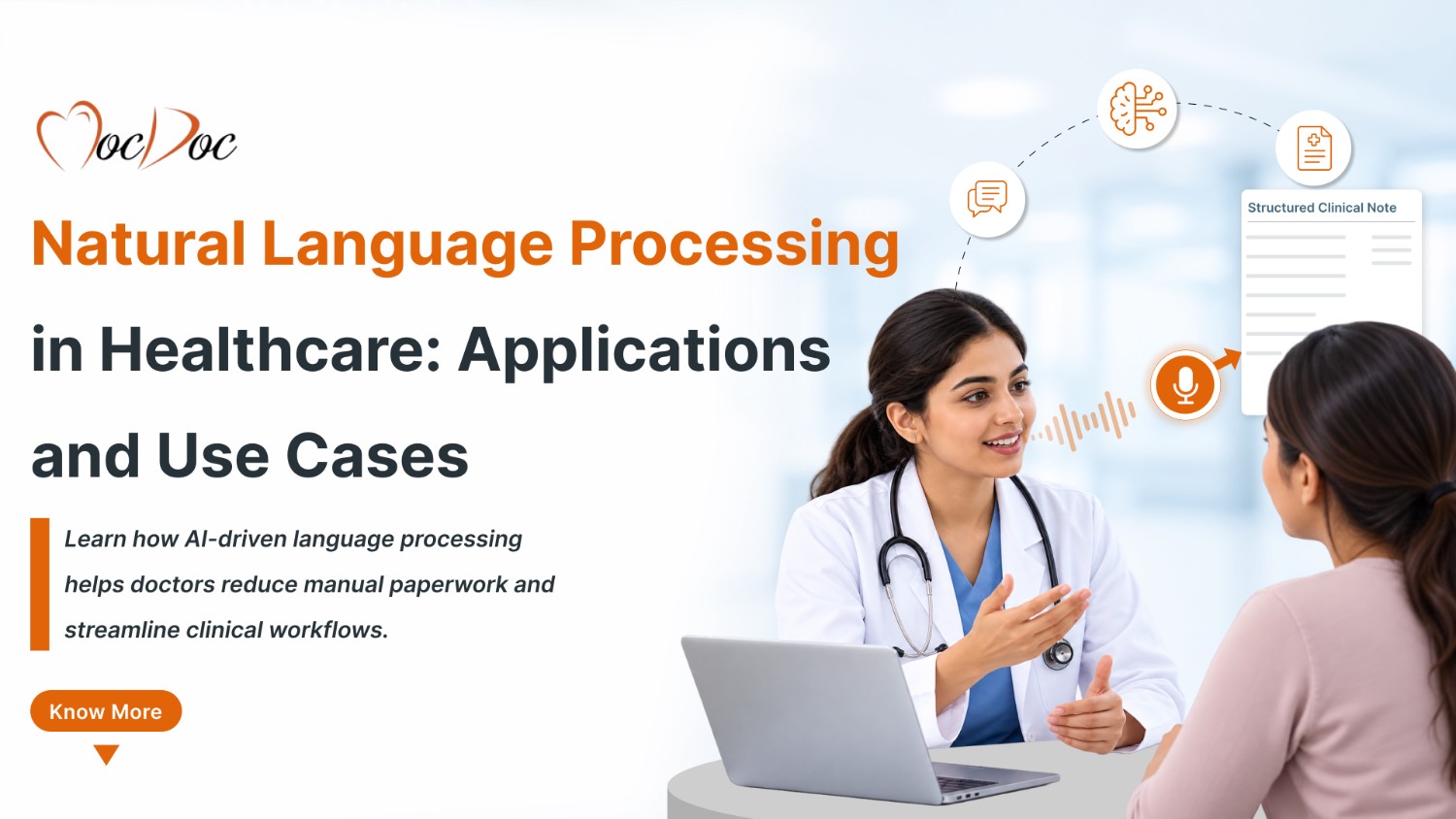
The technology that has had great impact is the Natural Language Processing (NLP) technology. Through this technology, the computer will be able to comprehend human languages, thus enabling healthcare professionals to digitize their data.
As a result of the adoption of AI in hospital management, the NLP technology is becoming increasingly relevant.
What is Natural Language Processing in Healthcare?
The application of NLP is quite relevant in medicine as it enables computers to interpret the human language and translate it into data.
The doctors face patients who dictate the notes concerning the clinical observations, take notes, record treatment and so forth. In the past, the data inputting process into the hospital management system was carried out manually.
NLP can help make this process easier.
- Understands clinical language: NLP can identify important information from spoken or written healthcare conversations.
- Converts speech into text: It can turn a doctor's spoken words into digital text.
- Identifies relevant information: Symptoms, complaints, observations, and other clinical details can be recognized from conversations.
- Supports structured documentation: Unstructured conversations can be organized into relevant clinical sections.
- Works with AI-powered healthcare software: NLP can become part of an AI-powered HMS software, EMR, or clinical documentation workflow.
In simple terms, NLP helps healthcare software understand what doctors and patients are saying.
Five Stages of NLP in Healthcare
NLP usually involves several stages to turn natural language into useful information.
- 1. Input through Speech/Text: This process starts off when the input is supplied either by speaking, dictating or writing some information.
- 2. Speech-to-Text: In case of inputs through speech, the system is able to convert the speech into text which can be analyzed.
- 3. Language Processing: Once the input has been changed to text, the system is able to analyze the text and understand the context.
- 4. Information Extraction: Clinical information related to symptoms, patient’s history and observation can be extracted from the input.
- 5. Structured Output: After analyzing the input and extracting relevant clinical information, it can then be presented in a useful form for doctors to use.
This process helps transform everyday conversations into information that can support digital clinical documentation.
NLP vs AI Clinical Scribe
NLP and AI Clinical Scribes are closely connected, but they are not exactly the same.
| NLP | AI Clinical Scribe |
| Technology used to understand human language | Healthcare application that uses AI and NLP |
| Processes speech or text | Captures clinical conversations and documentation |
| Can extract and classify information | Helps create structured clinical notes |
| Used across many industries | Specifically designed for clinical workflows |
| Acts as an underlying technology | Works as a practical documentation solution |
In simple words, NLP is the technology, while an AI Clinical Scribe is one practical healthcare application of that technology.
How AI Clinical Scribes Are Evolving Healthcare
Doctors spend a significant amount of time documenting patient information. While documentation is essential, repetitive typing and note-taking can take attention away from the patient.
AI Clinical Scribes are changing this workflow.
- Less manual typing: Doctors can speak naturally instead of typing every detail manually.
- Faster documentation: Relevant information can be converted into structured clinical documentation more efficiently.
- Better patient interaction: Reducing documentation work can give doctors more opportunity to focus on listening and interacting with patients.
- Multilingual support: Healthcare conversations can happen in different languages, making multilingual AI particularly useful in diverse healthcare environments.
- Connected EMR workflows: When an AI scribe is integrated with an EMR, doctors can review and approve documentation within their existing workflow.
- Support for AI-powered HMS: NLP and AI can become part of a wider AI-driven hospital management system, supporting clinical documentation alongside other hospital operations.
The goal is not to replace doctors. The goal is to reduce repetitive work and give doctors more time for what matters most — patient care.
MocDoc SenZ – AI Clinical Scribe for Modern Healthcare
MocDoc SenZ is an AI Medical Scribe designed for hospitals, multi-specialty clinics, and dental clinics across India.
Built into the MocDoc Hospital & Clinic Management + EMR platform, SenZ helps doctors document clinical information without creating a separate workflow.
Two Ways to Document
- Transcribe: During an OP or IP consultation, doctors can speak naturally while MocDoc SenZ captures the conversation and converts relevant information into structured clinical documentation. The doctor can review, edit, and approve the final note.
- Transcript: Doctors can dictate directly into supported clinical fields. The spoken content is converted into clean English text without restructuring the information.
Built for Real Clinical Conversations
MocDoc SenZ supports conversations in multiple Indian languages, including English, Hindi, Tamil, Telugu, Kannada, Malayalam, and Marathi.
It can support workflows such as OP consultations, IP documentation, clinical notes, discharge documentation, and dental consultations, depending on the configured MocDoc workflow.
Integrated with MocDoc EMR
Instead of moving between separate systems, doctors can use AI-assisted documentation within the MocDoc environment.
The workflow is simple:
Consult → AI Generates → Doctor Reviews → Approve & Save
The doctor remains responsible for reviewing and approving the final clinical record.
Conclusion
Natural Language Processing is helping healthcare move from manual documentation toward smarter digital workflows. When combined with AI, NLP can support everything from speech recognition and information extraction to structured clinical documentation.
For hospitals and clinics looking to adopt an AI-powered hospital management system, AI-powered EMR, or AI-driven clinical documentation solution, technologies such as AI Clinical Scribes can make everyday workflows more efficient.
MocDoc SenZ brings AI-assisted clinical documentation closer to the point of care — helping doctors spend less time on paperwork and more time with patients.
Ready to Experience AI-Powered Clinical Documentation?
See how MocDoc SenZ can fit into your hospital or clinic workflow.
Book a Demo with MocDoc today and discover a smarter way to document patient care.