Multilingual AI Medical Scribe for Indian Healthcare | MocDoc
Posted On
2026091513:22:12
By
Mohammed Siddiq
Introduction
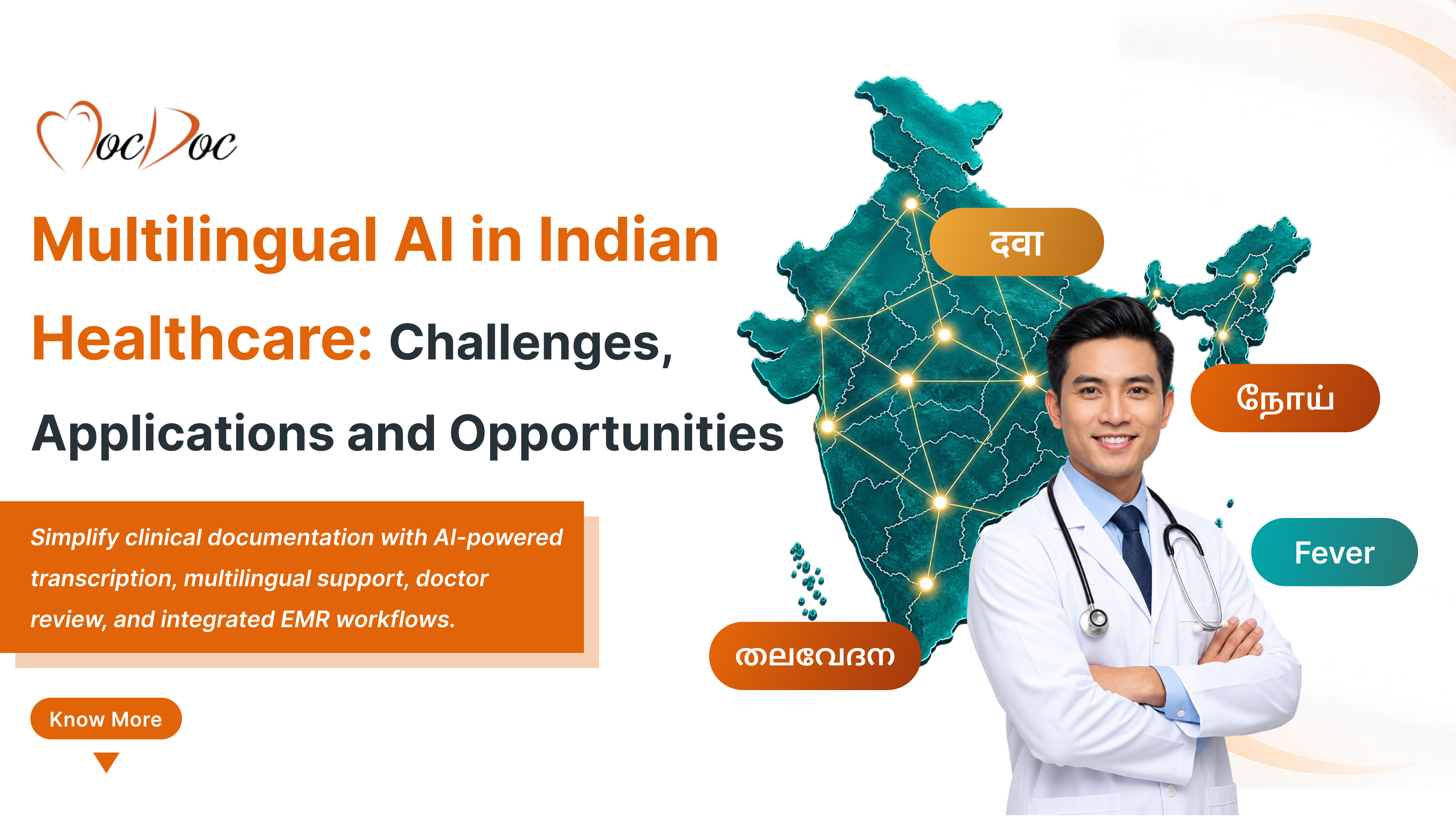
The healthcare system in India caters to people who have varied language skills. The same doctor may communicate with a person in English, another person in Hindi, and a third person in Tamil, Telugu, Kannada, Malayalam, or Marathi.
This is a crucial issue with respect to the implementation of digital health care technology. Communication barriers should be solved by technology and not increased.
It is here that Multilingual AI can prove to be very helpful. AI-assisted clinical documentation will be able to recognize conversations in multiple languages and will assist in generating medical documentation from that conversation.
The work of AI Clinical Scribe will become easier in this regard through minimizing the typing effort of doctors along with reviewing the generated documentation.
Multilingual AI in Indian Healthcare
The choice of language is critical in terms of patient care. Patients will feel at ease when speaking in their language and will therefore be able to narrate their symptoms, history, concerns, and other information.
Nevertheless, the healthcare technology sector has historically been based on typing information. The physician needs to listen to the patient, jot down information, enter the information in the EMR, fill prescriptions, and do follow-ups.
Multilingual AI can prove to be useful in solving such problems.
An AI Medical Scribe can assist in listening to the medical conversation, finding information in it, and assisting in making documentation out of it. Rather than asking the physicians to change their mode of communication, the technology is able to adapt to it.
Such technology can prove to be helpful for Indian hospitals, which use multiple languages in different departments.
What Are the Challenges of Multilingual Healthcare?
Implementing multilingual technology in healthcare is not as simple as translating words from one language to another. Clinical conversations contain medical terminology, abbreviations, local expressions, mixed-language sentences, and context that can change the meaning of a statement.
Some common challenges include:
| Challenge | Impact on Healthcare |
| Multiple languages | Doctors may handle patients speaking different languages |
| Language switching | Patients and doctors may move between languages during one consultation |
| Medical terminology | Clinical terms require context, not simple word-to-word translation |
| Manual documentation | Doctors may spend additional time converting conversations into notes |
| Regional communication | Patients may use local words to describe symptoms |
| Documentation consistency | Different documentation styles can make records harder to standardize |
| EMR data entry | Information may need to be manually entered after consultation |
| Doctor workload | More documentation can reduce time available for patient interaction |
These challenges show why multilingual healthcare AI needs to understand clinical context, not just speech.
How AI Clinical Scribe Supports Multilingual Documentation
A conventional speech-to-text system mainly converts spoken words into written text. An AI Clinical Scribe goes a step further by helping organize relevant clinical information.
MocDoc SenZ is designed to follow clinical conversations in:
English · Hindi · Tamil · Telugu · Kannada · Malayalam · Marathi
Doctors can speak naturally during a consultation without using special commands or changing their usual communication style.
The workflow is simple:
Doctor-patient conversation → AI processing → Clinical information → Structured documentation → Doctor review → EMR
The doctor remains responsible for checking the generated information. Any correction or clarification can be made before the documentation is approved and saved.
This review step is important because AI-assisted documentation should support clinical work, not replace professional judgment.
AI Medical Scribe Applications in Indian Healthcare
Multilingual AI can support several areas of healthcare documentation.
OP Consultations
During outpatient consultations, doctors can speak naturally while the AI Clinical Scribe captures relevant information and helps organize it into structured clinical documentation.
IP Documentation
For inpatient workflows, doctors can use AI-assisted documentation for supported clinical notes. Field-level dictation can also help when a doctor wants to speak directly into a specific documentation field.
Discharge Summaries
Doctors often need to complete several sections while preparing discharge documentation. AI-assisted transcription can reduce the amount of manual typing required in supported fields.
Clinical Notes
Physician notes, nursing notes, and other clinical documentation can benefit from speech-based data entry where supported by the workflow.
Dental Documentation
Multilingual AI can also support documentation in dental workflows, helping practices reduce repetitive manual note-taking.
Opportunities with AI Medical Scribe in India
The opportunity for multilingual AI in healthcare extends beyond simply making documentation faster.
For hospitals, it can help create a more connected digital workflow where conversations, clinical documentation, and patient records work together.
For doctors, it can reduce repetitive typing and allow more attention to be given to the patient.
For patients, speaking naturally in a familiar language can make consultations more comfortable.
For healthcare organizations, AI-assisted documentation can support more structured digital records while fitting into existing hospital workflows.
The long-term opportunity is to make healthcare technology more accessible to India's diverse linguistic population without forcing every patient or doctor into the same communication style.
MocDoc SenZ – AI Medical Scribe Integrated with Hospital Management Software
MocDoc SenZ brings multilingual AI-assisted documentation into the MocDoc Hospital & Clinic Management + EMR platform.
Rather than working as a completely separate application, MocDoc SenZ is designed to work within the existing clinical workflow.
It provides two documentation approaches.
Transcribe captures relevant information from OP or IP consultations and organizes it into structured clinical documentation.
Transcript converts the doctor's speech into clean English text directly within a supported clinical field. This can be useful for IP notes, discharge summaries, physician notes, and other field-based documentation.
The doctor can review, edit, and approve the content before it becomes part of the patient record.
MocDoc SenZ also works alongside the wider MocDoc ecosystem, including OPD, IPD, EMR, Clinical Case Sheets, Laboratory, Pharmacy, Billing, Appointments, and hospital operations.
This connected approach helps reduce the need to move between separate documentation tools and the patient record.
One AI Scribe. Multiple Languages. One Connected Workflow.
The real value of multilingual AI is not simply understanding different languages. It is making that understanding useful within the clinical workflow.
With MocDoc SenZ, doctors can communicate naturally, use AI-assisted documentation, review the generated content, and save approved information within the connected EMR environment.
For Indian healthcare organizations, this creates an opportunity to bring language flexibility and digital documentation closer together.
Conclusion
India's multilinguiality is another critical factor when developing practical digital health tools. Multilingual AI will contribute to making medical technology more intuitive, accessible, and user-friendly.
An AI Medical Scribe will minimize the amount of routine documentation, while multilingualism will enable communications in various Indian languages.
The MocDoc SenZ system is the combination of AI Clinical Scribe technology, multilingual documentation, automation of clinical notes, field level transcription, and EMR integration into the MocDoc Hospital & Clinic Management solution.
What we need is to type less and see more patients
Book a Demo
See how MocDoc SenZ is capable of handling clinical documentation with multilingual AI assistance in your healthcare facility.
Schedule a demo now and see how you can integrate all aspects of conversations, clinical documentation, and patient information.
MocDoc SenZ — AI Clinical Scribe by MocDoc.