AI-Powered vs Traditional Healthcare Software: Key Differences
Posted On
2026092513:22:12
By
Mohammed Siddiq
Healthcare software has changed a lot over the years. Earlier, hospital software mainly helped staff record patient details, manage appointments, create bills, maintain pharmacy records, and store medical information.
Today, healthcare organisations are looking beyond basic automation. With AI in Hospital Management, software can also assist with clinical documentation, information processing, and everyday workflows.
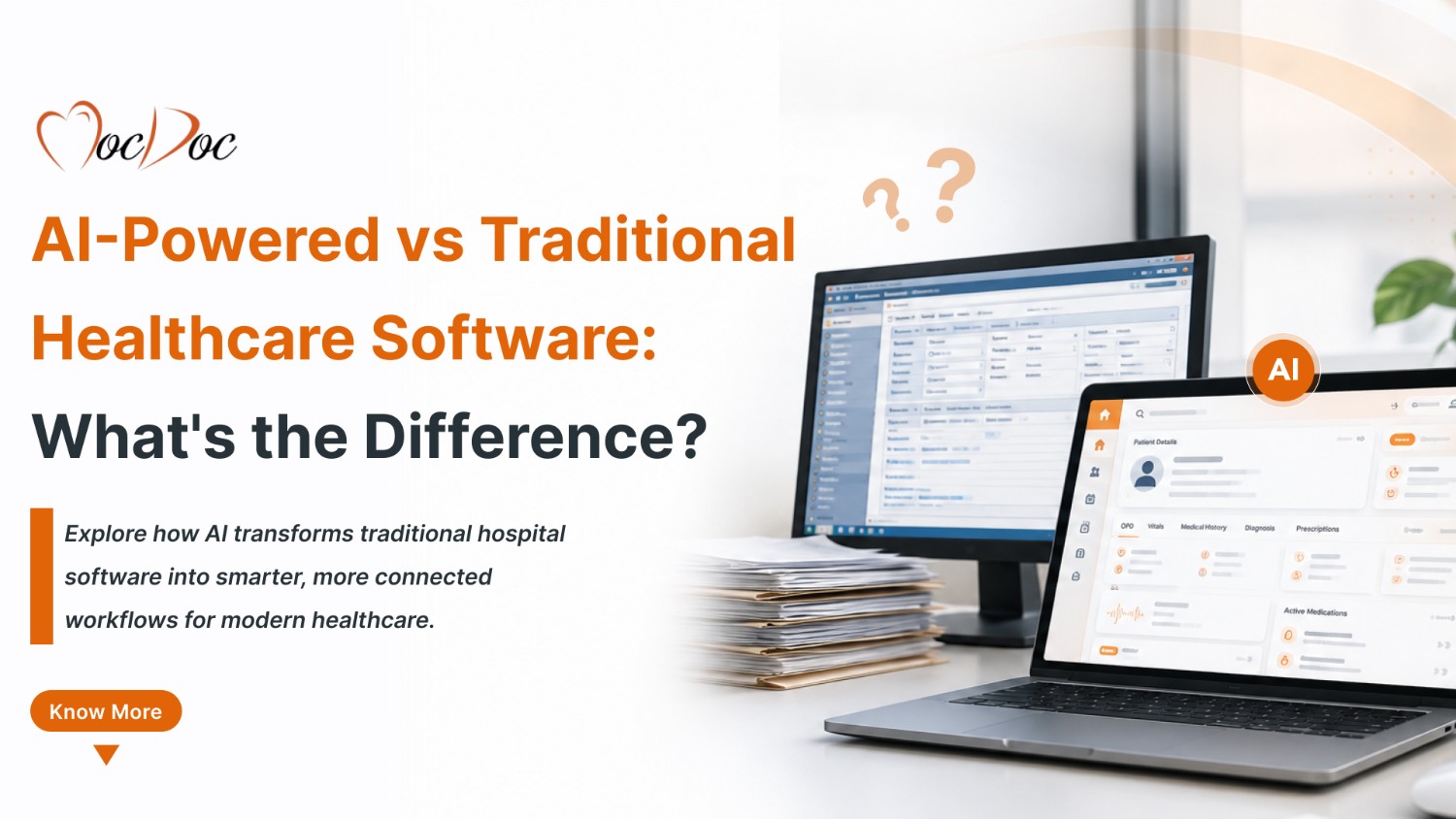
So, what is the difference between traditional healthcare software and an AI Powered Hospital Management System? The biggest difference is how the software supports people. Traditional systems mainly store and manage information, while AI-enabled systems can also help process information and assist users with certain tasks.
Traditional Hospital Management Software vs AI-Powered Hospital Management Software
The difference becomes easier to understand when we look at their everyday use.
| Aspect | Traditional Hospital Management Software | AI-Powered Hospital Management Software |
| Patient Records | Stores and manages patient information | Helps organise and process relevant information |
| Documentation | Mostly manual data entry | AI-assisted documentation |
| Clinical Notes | Doctors type or dictate manually | AI can assist in creating structured notes |
| Consultation Documentation | Manual note-taking | Conversation can be converted into clinical documentation |
| EMR | Stores electronic medical records | Can support smarter documentation within the EMR |
| Workflow Support | Rule-based workflows | Can include AI-assisted workflows |
| Language Support | Usually depends on manual input | AI can support multilingual conversations in supported systems |
| Doctor's Work | More manual documentation | Less repetitive documentation |
| Data Processing | Mainly record management | Can assist with processing and organising information |
| Decision Support | Depends on configured rules | Can support AI-assisted clinical workflows and CDSS capabilities where available |
Traditional software is still useful for many essential hospital operations. The difference is that AI-powered software adds another layer of assistance on top of these basic digital workflows.
Why Is AI-Powered Hospital Management Software the Future?
Healthcare is producing more information than ever before. Every consultation can involve patient history, symptoms, observations, prescriptions, test results, clinical notes, and follow-up information.
Managing all this information manually can take time.
AI-powered healthcare software can help reduce some of this repetitive work. Instead of simply recording information, AI can assist with tasks such as documentation, transcription, information organisation, and other configured workflows.
The goal is not to replace healthcare professionals. It is to give them better tools to manage their daily work.
How Can Doctors Use AI in Hospital Management?
For doctors, one of the most practical applications of AI is clinical documentation.
A doctor may spend a significant part of the consultation listening to the patient while also trying to remember and record important clinical information. After the consultation, additional time may be required to complete the documentation.
An AI Clinical Scribe can assist with this process.
With MocDoc SenZ, doctors can speak naturally during a consultation. The system processes relevant information and prepares structured clinical documentation. The doctor then reviews, edits, and approves the information before it becomes part of the patient's record.
This creates a simple workflow:
Consult → AI Generates → Doctor Reviews → Approve & Save
The doctor remains in control of the final documentation.
Why Use AI Hospital Management Software?
Less Repetitive Work
Manual typing is still necessary for many healthcare processes, but not every part of documentation needs to be created from scratch.
AI-assisted tools can handle repetitive documentation tasks, allowing healthcare professionals to focus their time on work that requires their attention.
Faster Clinical Documentation
Doctors can speak naturally instead of typing every detail during or after a consultation. AI can then assist in organising the relevant information into the required clinical format.
More Patient Interaction
When documentation becomes easier, doctors can spend more attention listening to the patient and conducting the consultation instead of constantly switching between the patient and computer screen.
Better Connected Workflows
An AI-powered HMS Software can be more useful when AI features are connected to the hospital's existing EMR and management system.
Instead of using one application for consultation, another for AI documentation, and another for the patient record, an integrated platform can bring these steps closer together.
How Does AI-Powered EMR Change Documentation?
An AI Powered EMR goes beyond simply storing electronic patient records.
For example, a doctor may say:
“The patient has been experiencing fever and cough for three days. Temperature is 102°F. We will start treatment and review the patient in five days if symptoms continue.”
Instead of manually creating every section, an AI clinical documentation system can help organise relevant information into areas such as symptoms, history, vitals, diagnosis, prescription, and follow-up.
The doctor reviews the generated information before approving it.
This makes the EMR a more active part of the clinical workflow rather than only a place where information is stored.
AI Clinical Scribe: A Practical Example of AI in Healthcare
MocDoc SenZ is an example of how AI Driven Hospital Management can be applied to a real clinical workflow.
It provides two ways to document information.
Transcribe captures a consultation and converts relevant information into structured clinical documentation.
Transcript allows doctors to dictate directly into a supported clinical field, such as an IP note, physician note, or discharge documentation field.
SenZ also supports conversations in English, Hindi, Tamil, Telugu, Kannada, Malayalam, and Marathi.
This makes it suitable for healthcare environments where doctors and patients may naturally use different languages during a consultation.
AI-Powered Healthcare Software for Hospitals and Clinics
AI is not limited to large hospitals.
Multi-specialty clinics and dental practices can also benefit from AI-assisted documentation. MocDoc SenZ is designed to work across hospitals, clinics, and dental workflows within the MocDoc platform.
It can support areas such as:
- OP consultations
- IP documentation
- Clinical notes
- Discharge documentation
- Dental consultations
- Field-level dictation
The exact workflow depends on the documentation structure and configuration available in the organisation.
What About Clinical Decision Support System (CDSS)?
AI-powered healthcare software can also work alongside Clinical Decision Support System (CDSS) capabilities.
CDSS is designed to provide relevant clinical information or decision-support inputs based on configured data, rules, or clinical workflows.
However, documentation and clinical decision support are different functions. An AI Clinical Scribe such as MocDoc SenZ primarily helps with documentation. It does not replace the doctor's clinical judgement.
This distinction is important because AI should support healthcare professionals rather than make independent clinical decisions.
MocDoc SenZ: AI Clinical Scribe Software for Smarter Documentation
MocDoc SenZ brings AI-assisted clinical documentation into the MocDoc Hospital & Clinic Management + EMR platform.
Doctors can speak naturally, allow SenZ to assist with documentation, review the generated content, make corrections where needed, and approve the final record.
Because SenZ works within the MocDoc ecosystem, it can sit alongside workflows such as OPD, IPD, EMR, clinical case sheets, laboratory, pharmacy, billing, and appointments.
The result is a simpler approach to clinical documentation without asking doctors to learn an entirely separate workflow.
Conclusion
Traditional hospital management software has already made healthcare operations more organised by moving many manual processes into digital systems.
AI-powered healthcare software takes the next step by helping users work with information, not just store it.
For doctors, one of the clearest benefits can be seen in clinical documentation. AI Clinical Scribe technology can reduce repetitive typing, assist with note creation, and give doctors more time to focus on the patient.
MocDoc SenZ brings this approach directly into the MocDoc Hospital Management System and EMR environment.
Less typing. Better documentation. More time for patient care.
Book a Demo
Want to see how AI-assisted clinical documentation can fit into your hospital or clinic?
Book a Demo with MocDoc and explore MocDoc SenZ.
MocDoc SenZ — AI Clinical Scribe for Hospitals and Clinics.