AI Medical Scribes and Doctor Review: Why It Matters | MocDoc
Posted On
2026091913:22:12
By
Mohammed Siddiq
Introduction
Clinical Documentation is one of the essential processes in each hospital. Physicians need to document symptoms, clinical observations, diagnosis, treatment plan, prescriptions, and after-treatment instructions. However, doing all of this by hand in a busy hospital takes lots of time.
Especially when we talk about multi-specialty hospitals where physicians deal with different patients, different departments, and different ways of documenting throughout the day.
Here the AI Medical Scribe can help doctors. An AI Medical Scribe will not replace the clinical decision-making process, but it can listen to the consultation, extract necessary data, and create structured documentation for the doctor to look through.
And that's the key thing here: AI can help with documenting, but the physician should stay in charge of the final clinical document.
Manual Clinical Documentation vs AI Clinical Documentation with Hospital Management Software
Documentation through manuals is something that doctors are comfortable with as it allows them full control over the content of their documentation. However, it may be a tedious process of typing, bureaucracy, and record completion.
On the other hand, AI documentation done via Hospital Management Software follows a different methodology. It decreases repetition and still makes the doctor accountable for the information.
| Aspect | Manual Clinical Documentation | AI Clinical Documentation with HMS |
| Note creation | Doctor types manually | AI assists with documentation |
| Consultation capture | Manual note-taking | Natural conversation |
| Documentation time | Can be time-consuming | Helps reduce repetitive work |
| EMR entry | Manual process | Connected with EMR workflow |
| Doctor control | Direct control | Review, edit and approve |
| Field-level dictation | Manual typing | AI-assisted transcription |
| Patient record | Multiple manual steps | Connected patient record |
| Multilingual conversations | Depends on typing ability | Supports selected Indian languages |
| Clinical responsibility | Doctor | Doctor remains responsible |
AI does not make manual documentation unnecessary in every situation. Instead, it provides another way for hospitals to make documentation more efficient while maintaining appropriate human review.
Why Are Hospitals Focusing on AI Medical Scribes?
It has been observed that the healthcare sector is gradually moving towards digitization. This is because, along with large amounts of data for the patients, there is also an expectation from the doctors to maintain proper electronic data.
Doctors should have enough time to listen to the patient, examine them, explain their condition, and make their decisions clinically. It might happen that documentation work may distract them from such tasks.
The concept of AI Clinical Scribe Hospital Management Software links AI documentation to the overall workflow of the hospital.
In place of using one software for consultation, one software for AI documentation, and one for maintaining the patient's record, this approach can integrate all the processes into one.
Why AI Clinical Documentation Matters in the Modern Era
Modern hospitals need technology that supports both efficiency and better organization.
An AI Medical Scribe can assist doctors by capturing relevant information from conversations and converting it into structured clinical documentation. This can be particularly useful when doctors need to document several consultations in a short period.
The benefits can include:
- Less repetitive typing
- Faster clinical note preparation
- Reduced documentation workload
- Better workflow continuity
- Less after-hours charting
- More time for patient interaction
However, the value of AI does not come from removing the doctor from the process. It comes from helping the doctor complete documentation with less manual effort.
Why Human Oversight Matters
AI-generated clinical documentation should not automatically become the final medical record.
Clinical conversations can contain incomplete statements, unclear information, medical abbreviations, or details that require professional interpretation. An AI system may also misunderstand part of a conversation or organize information differently from what the doctor intended.
That is why doctor review is an important part of an AI Clinical Scribe workflow.
The process should be:
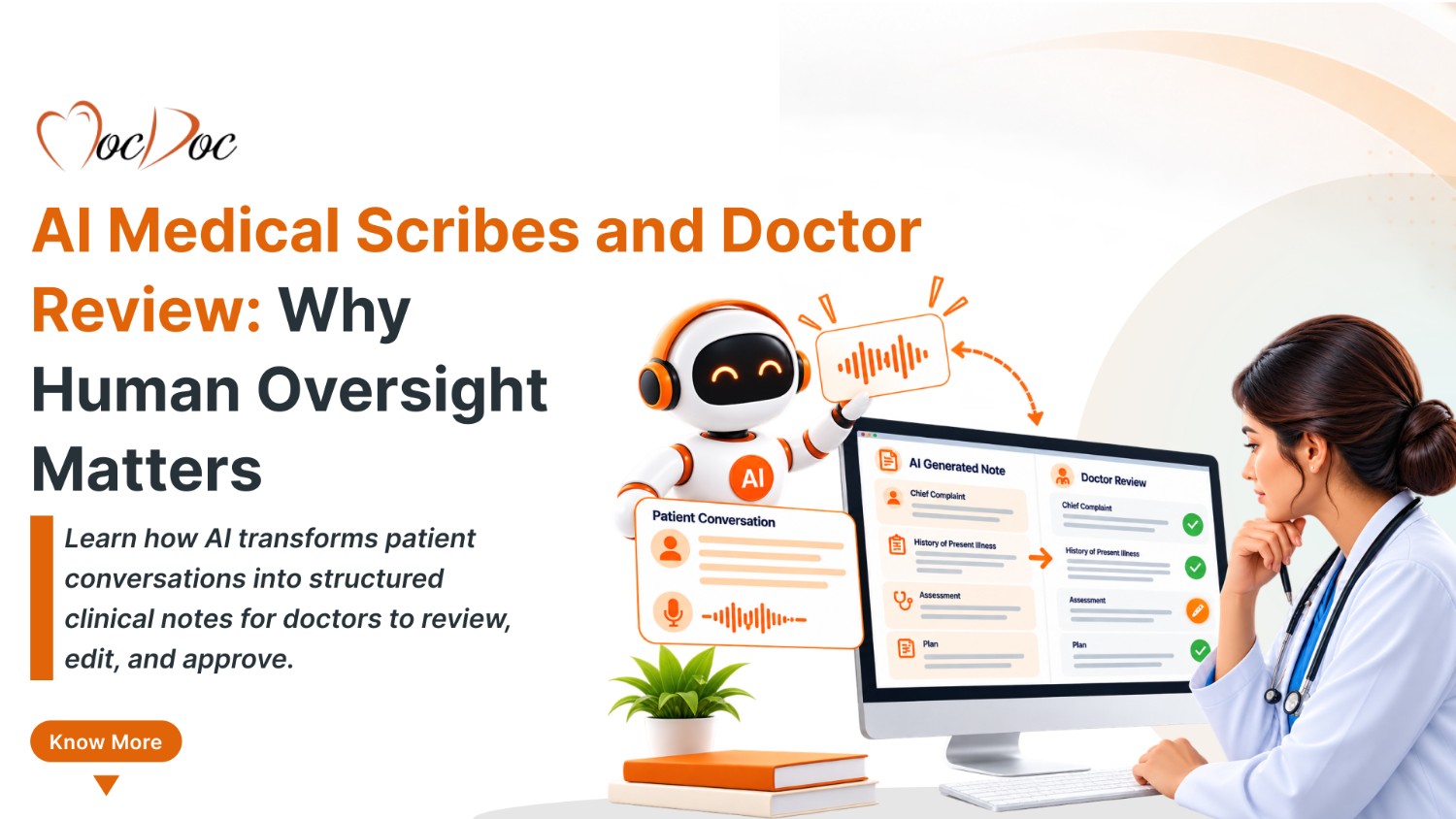
Consult → AI generates documentation → Doctor reviews → Doctor edits → Doctor approves → EMR record
The doctor can check whether the symptoms, clinical findings, diagnosis, medications, dosage, and follow-up information are correctly represented.
This creates a practical balance: AI handles repetitive documentation work, while the doctor provides clinical judgment and final approval.
MocDoc SenZ – AI Clinical Scribe Powered by MocDoc Healthcare Management Software
MocDoc SenZ is an AI Medical Scribe and clinical documentation solution designed for hospitals, multi-specialty clinics, and dental clinics across India.
It listens to doctor-patient conversations, understands relevant clinical context, and converts the captured information into structured clinical documentation for the doctor to review, edit, and approve.
MocDoc SenZ is built into the MocDoc Hospital & Clinic Management + EMR platform. This allows AI-assisted documentation to work within the clinical workflow instead of functioning as a completely separate tool.
Two Ways to Document
Transcribe converts consultation conversations into structured clinical documentation. It can support OP consultations, IP consultations, and routine check-ups.
Transcript allows doctors to dictate directly into supported clinical fields. This can be useful for IP notes, discharge summaries, physician notes, nursing notes, and other field-based documentation.
AI-Assisted, Doctor-Approved Documentation
MocDoc SenZ follows a simple four-step workflow:
01. Consult: The doctor speaks naturally with the patient.
02. AI Generates: MocDoc SenZ processes the conversation and prepares structured documentation.
03. Doctor Reviews: The doctor checks the information and makes corrections where required.
04. Approve & Save: The approved documentation is saved into the appropriate EMR record.
This approach keeps human oversight at the centre of AI-assisted clinical documentation.
One AI Scribe. One Workflow. One Patient Record.
Because MocDoc SenZ works within the broader MocDoc ecosystem, clinical documentation can remain connected with OPD, IPD, EMR, Clinical Case Sheets, Laboratory, Pharmacy, Billing, Appointments, and hospital operations.
It also supports clinical conversations in English, Hindi, Tamil, Telugu, Kannada, Malayalam, and Marathi, helping it fit into multilingual healthcare environments across India.
The objective is not simply to generate notes. It is to make documentation easier while keeping the doctor involved in every important step.
Conclusion
AI Medical Scribes are changing how clinical documentation can be handled in modern hospitals. But effective AI documentation is not about replacing doctors or removing human judgment.
It is about giving doctors better tools.
With MocDoc SenZ, AI can assist with capturing conversations and preparing structured clinical documentation, while doctors review, edit, and approve the final record.
For hospitals looking for AI Clinical Scribe, AI Medical Scribe, or AI Clinical Scribe Clinical Management Software, an integrated approach can help bring documentation closer to the point of care.
Let AI handle the repetitive work. Let doctors handle what matters most — patient care.
Book a Demo of MocDoc SenZ
Discover how AI-assisted clinical documentation can fit into your hospital's existing workflow.
Book a demo today and explore a smarter, more connected way to document clinical care.