Enhancing Financial Accountability in Laboratories
Posted On
2024112513:22:12
By
Mohammed Siddiq
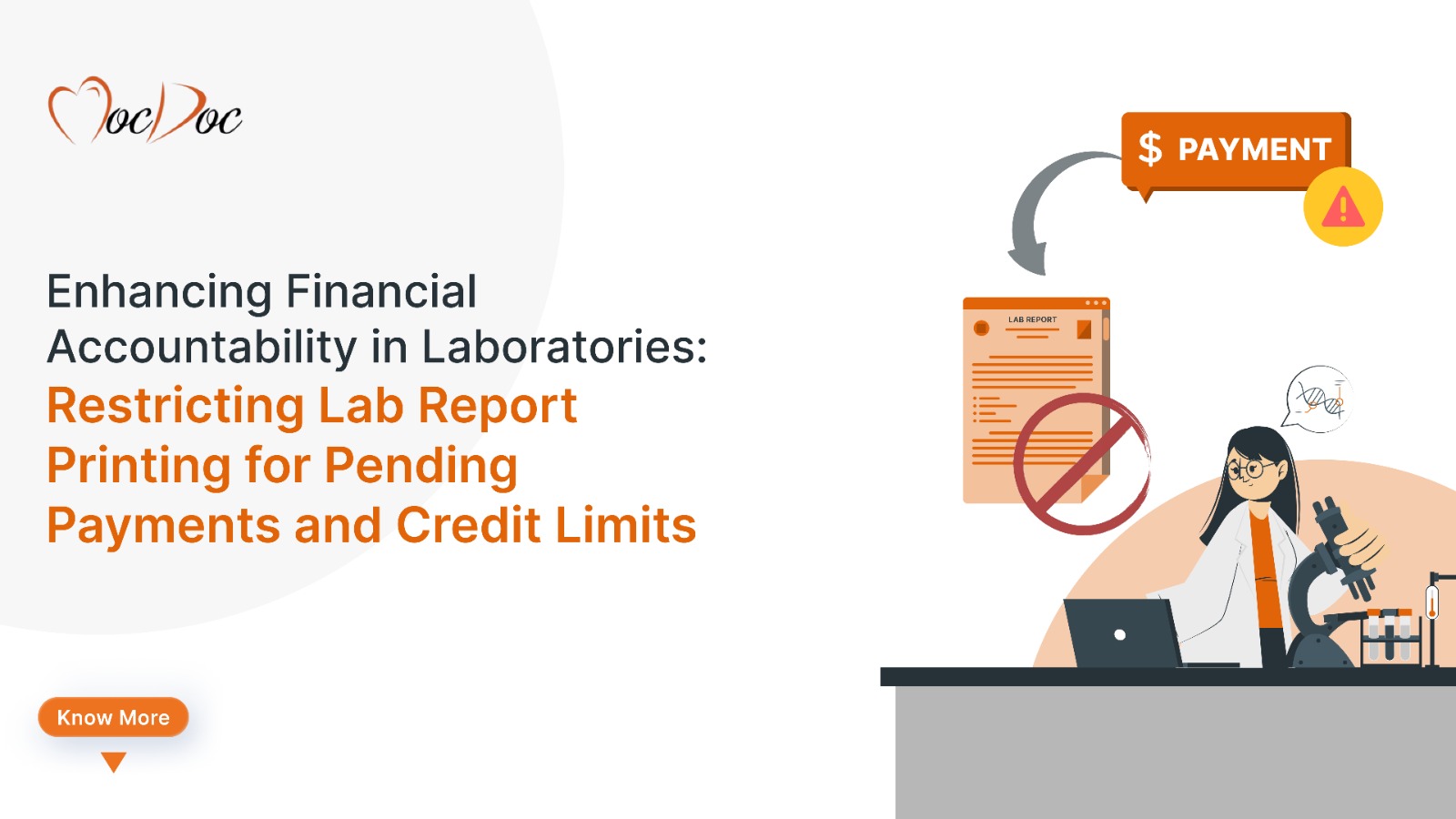
In a laboratory setting, maintaining financial accountability is as important as delivering timely and accurate results. Unsettled dues from patients and credit providers can lead to revenue losses and financial instability for labs. To address this challenge, MocDoc offers a robust feature that restricts lab report printing, email, SMS, and dispatch in cases of pending payments and exceeding credit limits. This feature ensures financial control while fostering responsible payment behaviour among patients and credit providers.
Addressing Payment Dues from Patients
Patients often collect their lab reports without clearing pending payments, which can disrupt the laboratory's cash flow. MocDoc provides a configuration that allows laboratories to enforce payment completion before report access.
How It Works:
- Configuration Setup: When the feature is enabled in the MocDoc application, any unpaid bills associated with a patient will trigger the restriction.
- Restrictions Applied: Lab Report Printing: The end-user (lab staff) cannot print the report until the bill is cleared. Digital Communication: Similarly, the report cannot be emailed or sent via SMS to the patient. Dispatch Restriction: Physical dispatch of reports is also disabled.
By enforcing these restrictions, laboratories can ensure that reports are only accessible after full payment, protecting their revenue and encouraging patients to settle dues promptly.
Managing Credit Providers with Exceeded Credit Limits
Credit providers, such as insurance companies or corporate partners, play a significant role in laboratory operations. However, if these credit providers exceed their agreed-upon credit limits and leave large amounts unsettled, it can impact the financial stability of the lab. MocDoc’s feature also extends to managing these scenarios effectively.
How It Works:
- Credit Limit Configuration: Laboratories can define a credit limit for each credit provider in the system.
- Automatic Restriction Trigger: If a credit provider exceeds their credit limit, the system automatically restricts the following functionalities: Printing: Lab reports cannot be printed. Email and SMS: Digital communication of reports is disabled. Dispatch: Physical dispatch of reports is restricted until the credit provider settles their outstanding dues.
This ensures that credit providers are held accountable for their financial obligations and prevents the accumulation of unpaid credit.
Benefits of the Restriction Feature
This feature delivers significant advantages for laboratories by streamlining financial management and ensuring operational efficiency.
1. Financial Control
By restricting access to lab reports until payments are settled, laboratories can effectively prevent revenue leakage.
2. Improved Cash Flow
Ensuring timely payments from both patients and credit providers strengthens the lab’s cash flow, supporting operational stability.
3. Accountability and Transparency
The system enforces accountability by making it clear to patients and credit providers that access to reports is contingent on settling dues.
4. Flexibility in Management
Laboratories can configure credit limits for providers and enforce restrictions dynamically, tailoring the system to their financial policies.
5. Operational Efficiency
The automation of restrictions eliminates the need for manual tracking of dues, freeing up staff to focus on core laboratory functions.
A Step Towards Sustainable Laboratory Operations
MocDoc’s restriction feature reflects its commitment to supporting laboratories in achieving financial sustainability without compromising patient care. By integrating financial accountability with operational processes, this feature helps labs maintain a balance between providing quality services and ensuring economic stability.
Laboratories can now manage unpaid bills and exceeded credit limits with confidence, fostering a culture of timely payments and responsible credit management.
Conclusion
Unpaid bills and exceeded credit limits are common challenges in laboratory operations. MocDoc’s restriction feature empowers laboratories to address these issues proactively, ensuring smooth workflows and financial health. This feature is a vital step towards building a financially sustainable and operationally efficient laboratory ecosystem.